
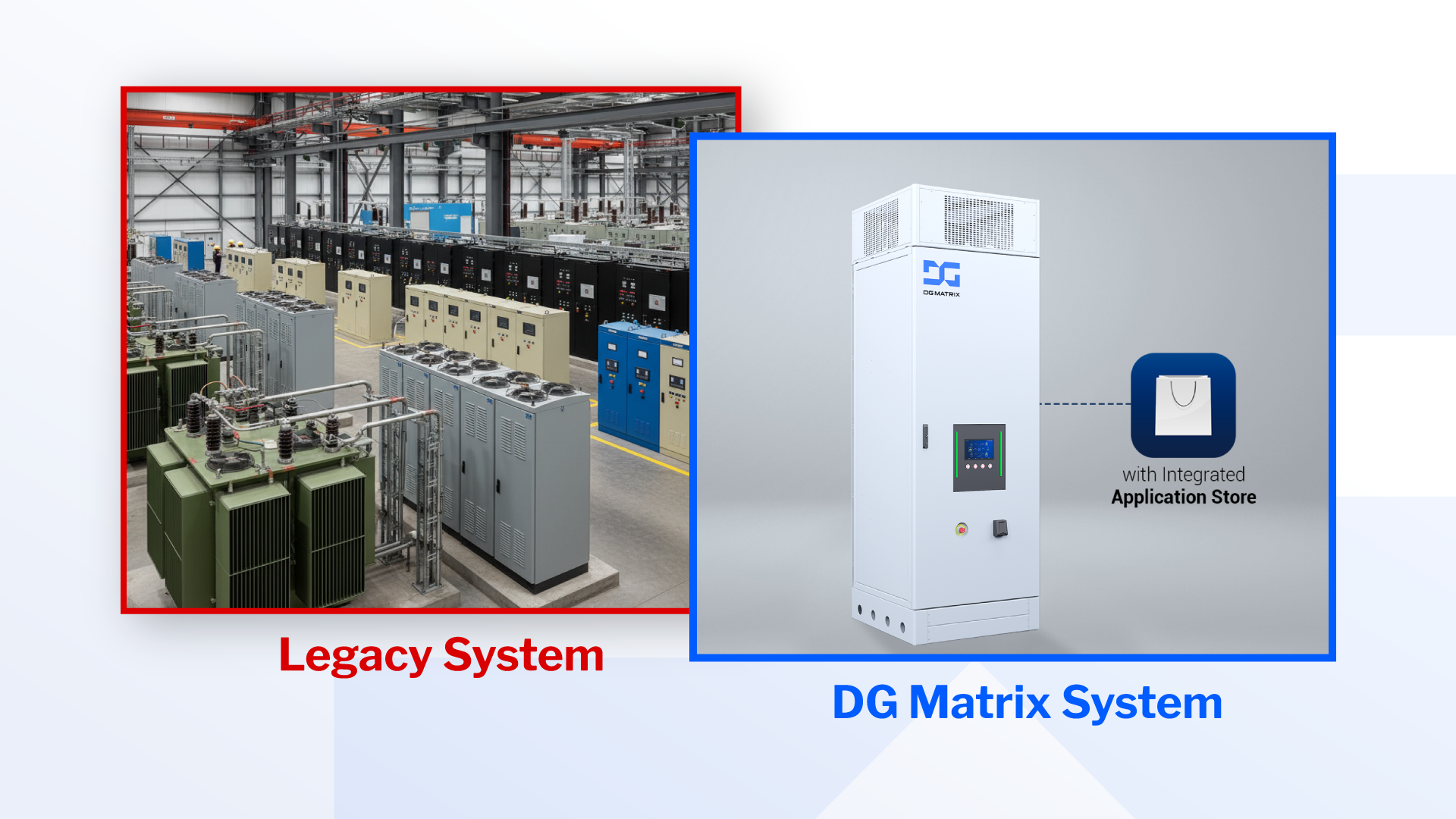
Power projects are often built as rigid, one-off stacks of transformers, rectifiers, switchgear, uninterruptible power supply (UPS) systems, and controls—unable to keep pace with AI-era demand. A better model is a power operating system: standardized hardware with software-defined adaptability that deploys quickly, evolves over time, and transforms distributed energy resources (DERs) into a controllable, revenue-generating fleet. DG Matrix drives this shift—“not just a product, a platform”—anchored in a multi-port solid-state transformer (SST).
Definition of a Power Operating System
A “Power Operating System” combines three layers: A Scalable System Architecture: One platform spans multiple use cases—electric vehicle (EV) hubs, buildings, microgrids, and especially AI-data centers—so teams can standardize designs, processes, and spares globally. A Software Layer: Features like dynamic-power sharing, demand-charge mitigation, time-of-use (TOU) optimization, and grid services are activated and evolved in software—the “App Store” model for energy. Value grows after installation as new functions roll out. A Universal Power Engine: The DG Matrix InterportTM platform is an SST that natively aggregates multiple alternating current (AC) and direct current (DC) sources and loads in a single device, with bi-directional, grid-forming and grid-following capabilities, with galvanic isolation and programmable ports. This consolidation collapses many discrete boxes into one controllable platform.
From Projects to Standardized Solutions
The bottleneck is no longer graphics processing units (GPUs) but rather grid upgrades that take years. DG Matrix solves this by delivering modular, behind-the-meter capacity—integrating on-site sources, storage, and load—to avoid upstream upgrades and cut timelines from years to months. DG Matrix packages this as a data center-ready stack:
Interport Flex Series: the site’s “power computer,” orchestrating grid, solar, fuel cells, gensets, and mission-critical loads.
Interport Cell-MV Series: brings medium-voltage to the rack to cut conversion steps and free white space.
Conclusion
The future of electrification—and AI-data-center power in particular—won’t be won by stacking more boxes. It will be won by standardized, software-defined power platforms that deploy quickly, evolve continuously, and turn edge assets into a coordinated, monetizable fleet. That’s what DG Matrix means by a power operating system—and why moving from one-off projects to a programmable platform is the decisive advantage in the AI decade.
Discover how DG Matrix's innovative power infrastructure solutions can transform your operations.
Contact Us