Discover the latest innovations, partnerships, and industry insights shaping the future of power infrastructure technology.
Get the latest news, event invitations, and exclusive insights delivered directly to your inbox.
For press releases, interviews, media kits, or collaboration opportunities, our communications team is here to help.
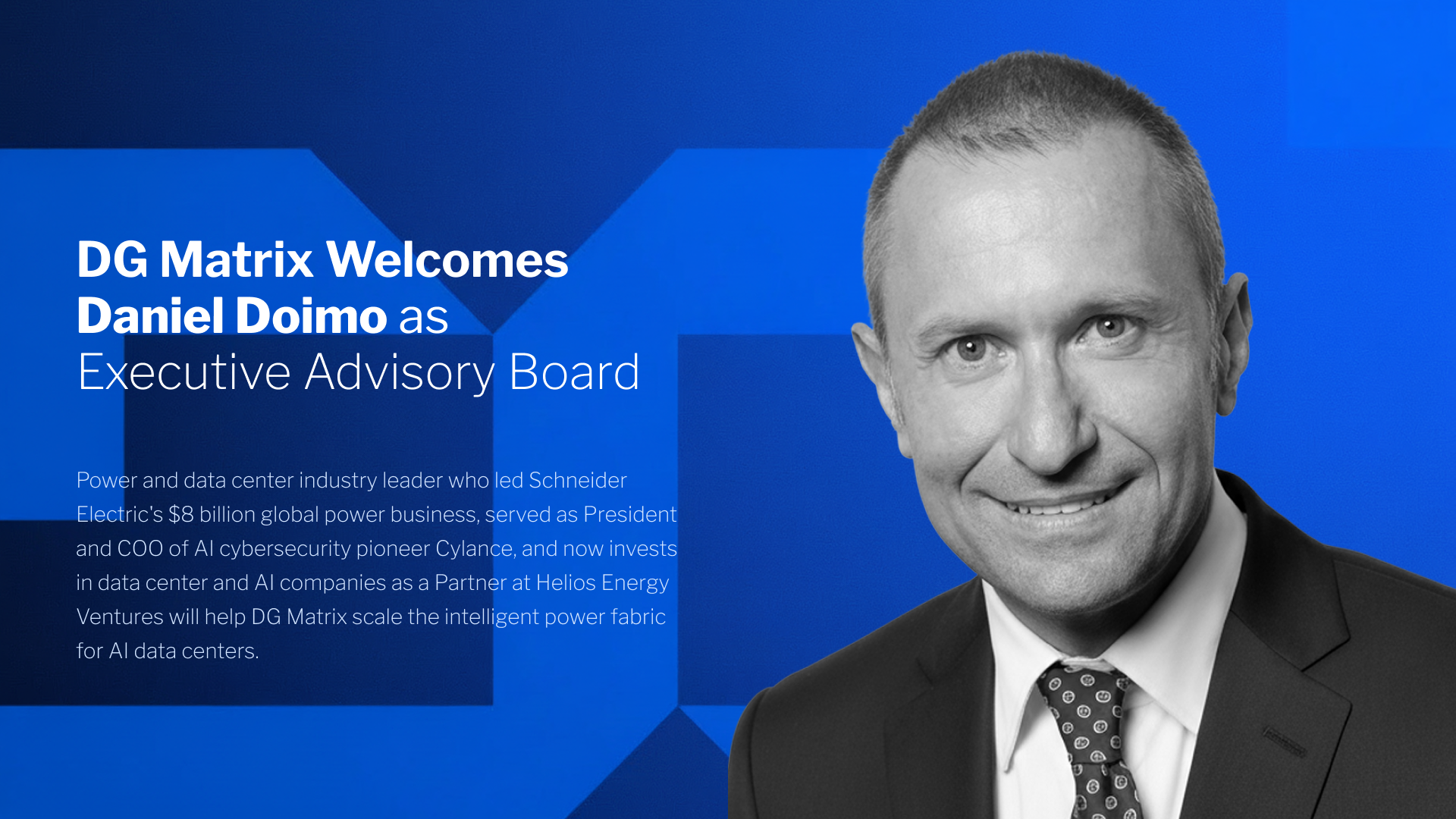
Power and datacenter industry leader who led Schneider Electric’s $8 billion global power business, served as President and COO of AI cybersecurity pioneer Cylance, and now invests in datacenter and AI companies as a partner at Helios Energy Ventures will help DG Matrix build and scale the intelligent power fabric for the AI datacenter. RALEIGH, N.C. & DURHAM, N.C.--(BUSINESS WIRE)--DG Matrix, the global leader in solid-state transformer solutions, today announced the appointment of Daniel Doimo, an executive who has built, merged and scaled some of the most important businesses in datacenter power, to its Executive Advisory Board. Doimo joins Christian Belady, the former head of Microsoft’s datacenter business and originator of the PUE metric, and Peter Gross, the mission-critical datacenter engineer who co-founded EYP Mission Critical Facilities, on a board that now brings together hyperscale operations, mission-critical design and the global power solutions and systems industry. Doimo will work with DG Matrix CEO Haroon Inam, Executive Chairman Anthony Wanger and the company’s engineering, solutions and commercial teams as DG Matrix builds the intelligent power fabric for the AI datacenter: the AI-driven control layer that manages every watt flowing from utility, on-site generation and storage sources to compute loads. Doimo has spent more than three decades building and scaling technology businesses across the United States, Europe and Asia. As a co-founder of MGE UPS Systems in 1996, he participated in two successive leveraged buyouts of the company, culminating in its acquisition by Schneider Electric in 2004, and then in Schneider Electric’s acquisition of American Power Conversion (APC). He led the merger of MGE and APC across Europe, the Middle East, Africa and Latin America and became Executive Vice President of the Data Center Business Unit with more than $3.2 billion in annual revenue. Over 12 years at Schneider Electric, Doimo served as Executive Vice President of Power, an $8 billion global business, and later as Executive Vice President of Global Solutions, and was a member of the company’s Executive Committee, reporting to the CEO. He also led the Electrical Distribution and Energy Management Business Unit and the company’s strategic vertical markets before uniting services, software and those end-user segments into a single Global Solutions organization. In 2017, he became President and Chief Operating Officer of Cylance. Today he is a Partner at Helios Energy Ventures, a venture capital firm focused on Series A and Series B investments in the datacenter and artificial intelligence sectors, where he works closely with founders to scale their businesses. “Daniel has built, merged and scaled the businesses that have powered datacenters for the past 30 years,” said Haroon Inam, CEO of DG Matrix. “He co-founded MGE UPS Systems, brought MGE and APC together inside Schneider Electric and led its $8 billion global power business, so he knows exactly how power infrastructure is specified, sold, serviced and scaled around the world — and he then took an AI company through hypergrowth to a successful exit. As DG Matrix moves from being first to commercialize the multi-port solid-state transformer to deploying it at scale, Daniel’s experience will sharpen how we build, deliver and service our solid-state transformer solutions and accelerate our path to becoming the intelligent power fabric of the industry.” “Daniel led the businesses that much of the datacenter industry buys its power systems from, and he scaled them across three continents,” said Anthony Wanger, Executive Chairman of DG Matrix. “With Christian, Peter and now Daniel, this advisory board has built the hyperscale datacenter, engineered the mission-critical facility and led the power business behind both.” “I spent most of my career building the solutions and systems that power datacenters and the past decade scaling AI and software businesses, and DG Matrix sits exactly where those two worlds are now colliding,” said Daniel Doimo. “For 30 years the industry has answered new demand by adding more boxes to the electrical room. The multi-port solid-state transformer is the first technology I have seen that fundamentally simplifies the datacenter electrical system, and DG Matrix has already done the hard part by commercializing it. I have taken companies through buyouts, mergers, acquisitions and the road to the public markets, and I am joining to help Haroon, Anthony and the team scale as fast as the AI buildout demands.” As a member of the DG Matrix Executive Advisory Board, Doimo will advise on commercial and go-to-market strategy, global operations and manufacturing scale-up, strategic partnerships across the power solutions and systems industry, and capital strategy. His appointment follows those of Belady in April and Gross in June, and the June appointment of Wanger as the company’s first Executive Chairman, as DG Matrix builds the team to scale and accelerates pilot deployments of its AI-enabled Interport platform with hyperscale, neocloud and colocation customers worldwide. About DG Matrix DG Matrix, the global leader in solid-state transformer solutions, is unlocking power as the binding constraint on AI. It is removing this critical bottleneck of stranded power by building the intelligent power fabric of the AI datacenter. Built on the world’s first commercially available, programmable multi-port solid-state transformer, the company’s AI-enabled Interport™ platform converts, routes and controls every electron, between the grid, on-site generation, storage and compute loads through a single, software-defined stage. DG Matrix delivers an integrated and simpler solution for faster deployment, lower energy costs, native 800 VDC readiness and protection from GPU pulse loads. Because speed to power is speed to inference, DG Matrix helps hyperscale, neocloud and colocation operators bring AI capacity online in months instead of years — at scale, anywhere in the world. Learn more at https://www.dgmatrix.com/.
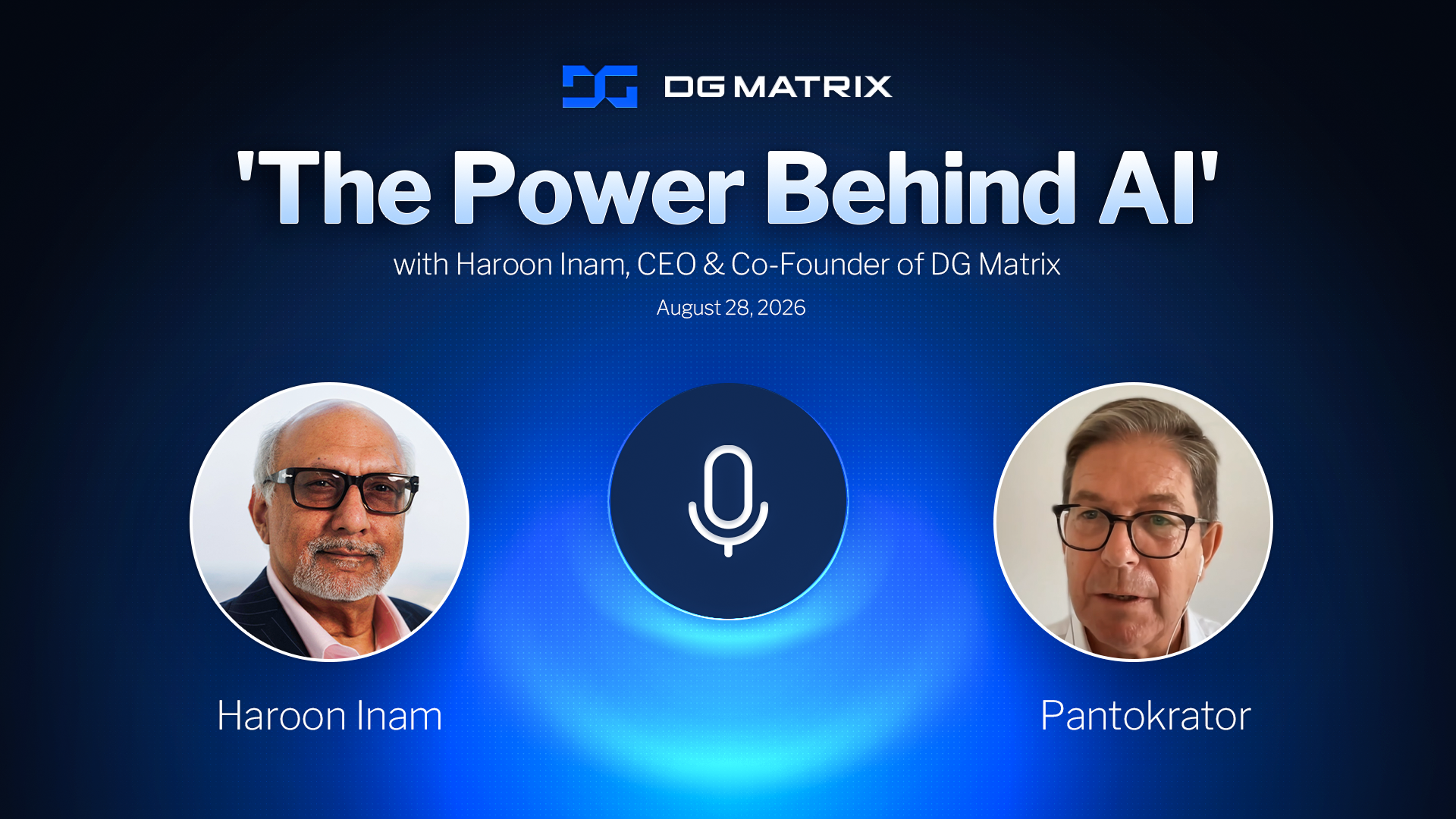
In this conversation, Haroon Inam, CEO of DG Matrix, discusses why power availability has become one of the defining constraints on AI infrastructure and how a new approach to power architecture can help meet the rapidly growing demands of AI data centers. Haroon explores how the DG Matrix Interport™ platform, a software-defined, multi-port solid-state transformer, integrates multiple energy sources and delivers power where it is needed across modern infrastructure. He also discusses the shift from conventional power conversion toward intelligent power routing and the role this transformation can play in accelerating the deployment of AI infrastructure. Topics covered include: Why power is becoming a critical bottleneck for AI growth How solid-state transformer technology can simplify legacy power architectures Integrating grid power, energy storage, and distributed generation Using software-defined power systems to improve infrastructure flexibility The DG Matrix vision for building the power fabric for the intelligence age “Power is the limit today. It’s not the GPUs or the chips.” — Haroon Inam See full podcast: 'The Power Behind AI' with Haroon Inam, CEO & Co-Founder of DG Matrix | Pantokrator Podcast
How Speed-to-Power Is Transforming AI Infrastructure and Energy Infrastructure Solutions Power availability has become one of the biggest challenges facing AI infrastructure, hyperscale data centers, and large-scale electrification projects. This white paper explains how the latest Federal Energy Regulatory Commission (FERC) large-load reforms are reshaping energy infrastructure by making speed-to-power a national priority. It explores how organizations can accelerate AI infrastructure deployment, modernize grid connections, and reduce delays through intelligent power solutions, electrification solutions, and software-defined energy platforms. How Interport™ Delivers Intelligent Power Solutions for the Next Generation of AI Infrastructure The white paper demonstrates how the DG Matrix Interport™ multi-port solid-state transformer (SST) platform addresses the challenges highlighted by FERC by integrating utility power, battery energy storage, distributed energy resources, renewable energy, and behind-the-meter generation into a unified software-defined energy platform. These advanced solid-state transformer solutions simplify electrical infrastructure, improve power management, recover stranded capacity, reduce dependence on utility upgrades, and enable faster deployment of AI data centers, commercial facilities, and electrification projects. Why Intelligent Power Solutions Will Define the Future of AI Infrastructure As AI infrastructure, advanced manufacturing, and electrification continue to increase electricity demand, organizations need more than additional grid capacity—they need intelligent energy infrastructure solutions that maximize existing resources. This white paper explains how solid-state transformer solutions, software-defined power, flexible energy architecture, and help organizations accelerate time-to-power, improve energy resiliency, support grid modernization, and build scalable, future-ready energy systems capable of meeting the next generation of AI workloads. Tags Speed-to-Power Intelligent Power Solutions Power Solutions for AI Data Centers AI Infrastructure Solutions Energy Infrastructure Solutions Next-Generation AI Infrastructure Grid Modernization Solid-State Transformer (SST) Solutions Battery Energy Storage Utility Power Integration
DG Matrix and Skeleton Technologies Join Forces to Deliver Resilient, Fast-Response Power for 800 VDC AI Data Centers Collaboration brings together Skeleton’s peak-shaving and backup power systems alongside DG Matrix Interport™ solid-state transformer technology for next-generation AI data center deployments MORRISVILLE, N.C. & TALLINN, Estonia--(BUSINESS WIRE)--DG Matrix, the global leader in solid-state transformer solutions, and Skeleton Technologies, a globally leading AI infrastructure power systems provider, today announced a strategic technical and commercial collaboration to support the data center industry’s transition to 800 VDC power infrastructure. The two companies are integrating Skeleton’s high-power, fast-response energy storage systems across DG Matrix’s galvanically isolated Interport™ multi-port solid-state transformer (SST) platform. The collaboration spans the Interport CM medium-voltage SST skid, which converts 12 34.5 kV AC directly to high-voltage DC; the Interport CL sidecar solution, which mitigates GPU pulse loads directly in the white space; and Interport Flex, an outdoor, grey space product that can be skid-mounted and paralleled into the Interport 360 end-to-end solution. Together, the technologies address one of the defining challenges in modern AI data centers: the extreme, repetitive pulse loads generated by GPU clusters that exceed the dynamic response capabilities of the power grid as well as conventional Uninterruptible Power Supply and battery systems. Skeleton’s power systems are engineered to respond in microseconds to minutes, absorbing peak loads before they propagate to upstream infrastructure, while DG Matrix’s Interport routes power in real time across AC and DC sources, loads, and storage at multiple voltage levels. As GPU cluster densities grow and power demands become increasingly dynamic, static power architectures can no longer keep pace. DG Matrix’s Interport platform already addresses this through software-defined, multi-port power routing and single-stage conversion. Pairing Interport with Skeleton’s fast-response storage closes the remaining gap, enabling the joint platform to absorb load transients, support fault ride-through, and deliver backup power with the speed and cycle life that AI workloads demand. “The shift to 800 VDC power architecture represents one of the most important evolutions in the data center industry. As power demands for AI workloads become even greater, fast-acting energy storage is essential to ensuring that GPU bursts don’t destabilize electric grids. Working with DG Matrix gives us the opportunity to demonstrate how our high-power energy storage technologies complement solid-state transformer architectures and support more resilient, efficient data center infrastructure,” said Taavi Madiberk, CEO and co-founder of Skeleton Technologies. Recent research from SemiAnalysis projects that approximately 39 gigawatts of incremental AI data center capacity will be served by 800 VDC architecture by 2030, with a solid-state transformer total addressable market of approximately $13 billion. DG Matrix’s Interport platform natively supports 800 VDC today, and Skeleton’s GrapheneCBU800 and GrapheneBBU800 systems are built for the same voltage class, positioning both companies at the center of that transition. “DG Matrix is building the power fabric for the intelligence age. By integrating Skeleton Technologies’ fast-response energy storage with our Interport solid-state transformer platform, we can advance a more complete architecture for AI data centers: one designed for dynamic pulse loads, resilient power, and faster deployment,” said Haroon Inam, CEO and co-founder of DG Matrix. About DG Matrix DG Matrix, the global leader in solid-state transformer solutions, is unlocking power as the binding constraint on AI. It is removing this critical bottleneck of stranded power by building the intelligent power fabric of the AI data center. Built on the world’s first commercially available, programmable multi-port solid-state transformer, the company’s AI-enabled Interport™ platform converts, routes and controls every electron, between the grid, on-site generation, storage and compute loads through a single, software-defined stage. DG Matrix delivers an integrated and simpler solution for faster deployment, lower energy costs, native 800 VDC readiness and protection from GPU pulse loads. Because speed to power is speed to inference, DG Matrix helps hyperscale, neocloud and colocation operators bring AI capacity online in months instead of years — at scale, anywhere in the world. Learn more at https://www.dgmatrix.com/. About Skeleton Technologies Skeleton Technologies is a leading provider of full-stack power systems that enable more efficient and scalable AI infrastructure. From rack-level power stabilization to grid scale integration, Skeleton helps hyperscalers, grid operators, and OEMs to optimize efficiency, power quality, and infrastructure utilization. Skeleton’s intelligent power systems are built on proprietary high-power energy storage technology, which has been deployed globally across grid infrastructure, data centers, mobility, aerospace, and defense applications over the past ten years. To learn more, visit https://www.skeletontech.com/.
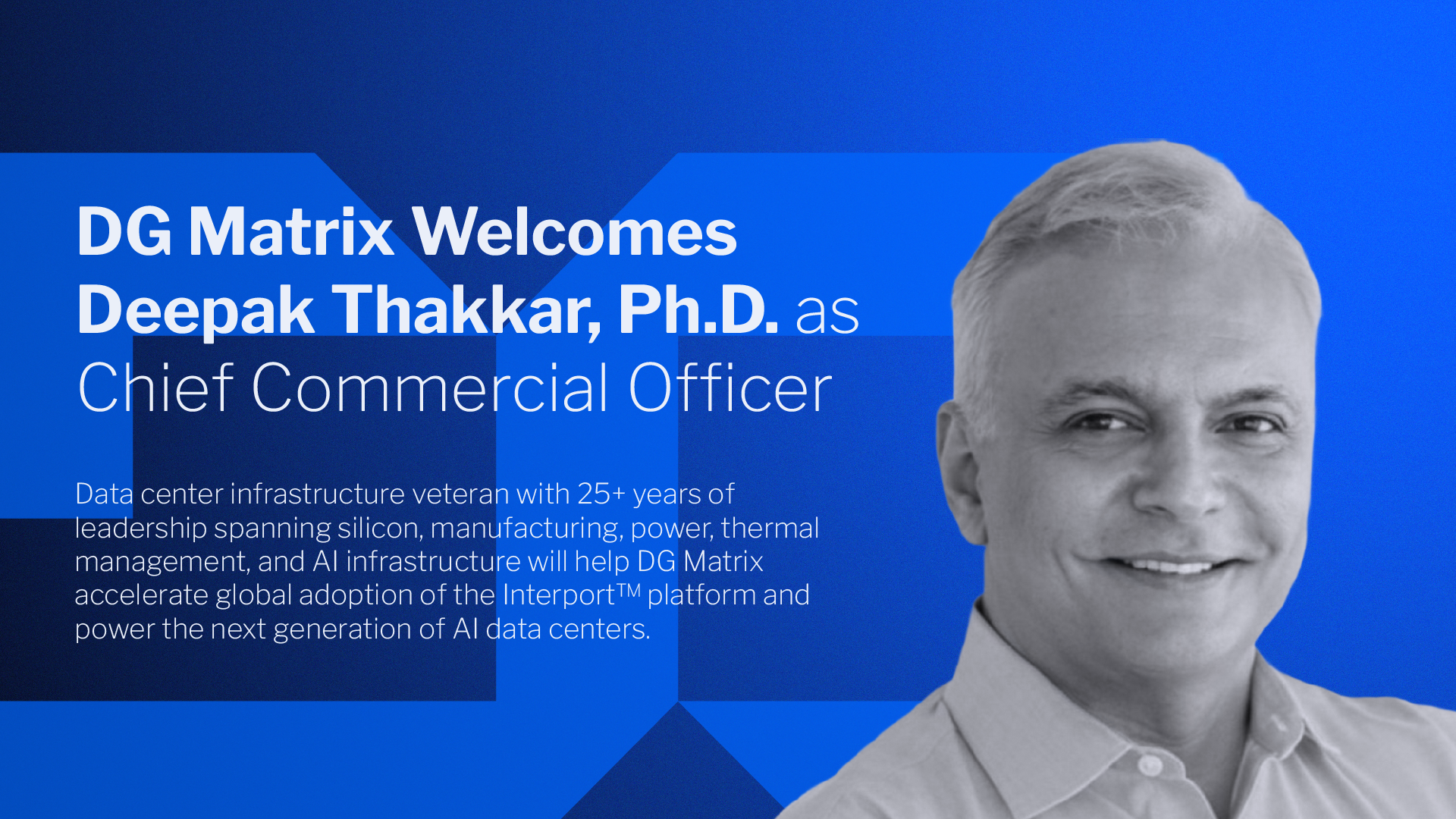
DG Matrix Appoints Data Center Infrastructure Veteran Deepak Thakkar, Ph.D., as Chief Commercial Officer A 25-year career spanning silicon, cybersecurity, manufacturing, power, cabling, and cooling gives Dr. Thakkar a rare perspective across the entire data center stack MORRISVILLE, N.C.--(BUSINESS WIRE)--DG Matrix, the global leader in solid-state transformer (SST) solutions, today announced the appointment of Deepak Thakkar, Ph.D., as Chief Commercial Officer. Dr. Thakkar will lead commercial strategy and customer engagement as DG Matrix accelerates deployment of its Interport™ platform across AI and conventional data center environments worldwide. Dr. Thakkar brings more than 25 years of leadership experience spanning virtually every layer of the data center infrastructure ecosystem. Prior to joining DG Matrix, he served as Chief Commercial Officer for portfolio companies within the data center thermal management practice of Neos Partners, where he helped institutionalize commercial operations and expand high-margin infrastructure opportunities. Previously, he served as Vice President of Sales at Boyd Corporation, whose thermal management business was acquired by Eaton in a $9.5 billion transaction, where he led growth initiatives across mission-critical thermal management markets. He also served as President of Global Sales at Electrical Components International (ECI), leading commercial strategies that contributed to a successful $2 billion exit. Earlier in his career, Dr. Thakkar spent nearly a decade at Flex (NASDAQ: FLEX) as Vice President of Business Development, managing executive relationships with leading OEM customers across North America, Europe, Korea, and India while overseeing more than $2 billion in annual outsourced manufacturing revenue. He also held senior data center business leadership roles at Intel, McAfee, and Silicon Graphics.“ I’ve spent my career watching each layer of the data center stack become increasingly optimized in isolation; chips here, cooling there, power elsewhere,” said Dr. Thakkar. “DG Matrix is the first platform I have seen that brings these domains together at the rack level. The opportunity to build the commercial engine around Interport, at this stage of the company’s growth, is exactly the challenge I have been looking for.” Dr. Thakkar’s approach to infrastructure investment decisions is rooted in economics and operational outcomes. According to the company, the DG Matrix Interport platform consolidates up to 15 discrete electrical components into four, reducing cooling and energy costs while lowering total cost of ownership to approximately one-half to two-thirds that of conventional architectures. Deployment timelines can be reduced from the industry’s typical 18 to 24 months to approximately six months. Fewer components also translate into fewer potential points of failure — a critical consideration in an industry where uptime directly drives revenue generation. “Deepak has spent his career operating across every layer of the data center stack, from silicon to cooling to power infrastructure,” said Haroon Inam, CEO of DG Matrix. “That perspective is exactly what DG Matrix needs as we position Interport as foundational infrastructure that must integrate seamlessly with everything else in the rack. Deepak approaches every opportunity through a commercial lens rather than as a science experiment, and that discipline will strengthen how we bring Interport to market.” As Chief Commercial Officer, Dr. Thakkar will build and scale DG Matrix’s commercial organization, deepen strategic relationships with hyperscalers, colocation providers, and data center developers, and accelerate market adoption of the Interport platform globally. He reports directly to CEO Haroon Inam and joins DG Matrix at a pivotal stage as the company expands deployments worldwide. About DG Matrix DG Matrix has commercialized the world’s first multi-port solid-state transformer designed to address the growing power infrastructure challenges associated with AI data centers and electrification. Its standardized Interport™ platform enables faster deployment, lower energy costs, and flexible integration of multiple energy sources and loads at scale, anywhere in the world. For more information, visit http://www.dgmatrix.com.
Built for the AI Factory DG Matrix Joins the NVIDIA MGX Ecosystem to Power the Next Era of Accelerated Computing DG Matrix is proud to join the NVIDIA MGX™ ecosystem as a solid-state transformer supplier for NVIDIA's 800 VDC power architecture. This milestone reflects more than two years of direct technical collaboration with NVIDIA, from the earliest prototypes of 800 VDC power architecture through the commercial launch of the Interport SST platform revealed at NVIDIA GTC 2026 in March. The partnership sits at the center of one of the most consequential transitions in data center history. As accelerated computing rack power densities advance, the industry's entire electrical backbone is being architected for 800 VDC distribution. NVIDIA MGX is the modular rack-scale reference architecture for AI factories, and the Interport SST is the power platform purpose-built to meet it. Recently this architecture was further detailed in SemiAnalysis’s latest deep dive study called " Inside the 800VDC Revolution – Part 1 " on May 25, a landmark technical report that maps the industry's four-phase shift to 800-volt DC architecture and sizes the solid-state transformer market at $13 billion by 2030. Why 800 Volts, Why Now 800 VDC is the power architecture and upgrade path that helps AI factories scale compute performance beyond the limits of traditional power distribution. SemiAnalysis makes the constraint concrete: a one-megawatt rack running on today's 48-volt architecture requires roughly 200 kilograms of copper busbars. At one-gigawatt campus scale, that is hundreds of tons of copper. "Copper becomes unmanageable at 48 to 54 volts," the report states. At 800 volts, the same 600-kilowatt load draws 750 amperes rather than 12,500. Resistive losses fall by a factor of 278. Future rack power density targets may not be reachable with legacy low-voltage distribution. SemiAnalysis projects that by 2030, approximately 39 gigawatts of incremental AI data center capacity will run on 800-volt architecture, with the transition saving more than 50 megawatts of continuous grid power per gigawatt of IT load. "Each shift happened anyway, because physics and the economics of compute do not negotiate. 800 VDC is next, and the logic is the same." — SemiAnalysis, Inside the 800 VDC Revolution, May 2026 The Interport SST: Purpose-Built for NVIDIA MGX The Interport SST was designed from the ground up for the demands of modular AI factory architecture. It natively supports 800 VDC today, with reprogrammable ports capable of reaching 1,500 volts to future-proof deployments against the next generation of accelerated computing platforms. A single-stage multi-port architecture delivers up to 98.5 percent conversion efficiency, integrated liquid cooling, and rack-proximate battery storage for dynamic GPU pulse-load response. That last capability matters in ways the efficiency numbers alone do not capture. DG Matrix collaborated with NVIDIA testing energy storage solutions for dynamic GPU load response, working through one of the hardest requirements in high-density AI compute: absorbing and supplying burst power at the speed of inference workloads. The Interport's multiport topology aggregates multiple AC and DC input sources simultaneously while delivering AC and DC outputs, giving operators a single converged platform for the full energy stack. DG Matrix's roots run deep on this problem. SemiAnalysis traces the company's origin to NC State including its FREEDM Systems Center, where the CTO of DG Matrix has been researching solid-state transformers and silicon-carbide transistors since 2008. That lineage, combined with backing from Clean Energy Ventures including ABB and a SiC supply partnership with Infineon, gives the Interport platform a technical foundation built over more than a decade of development. "The Interport SST brings modular, rack-proximate power that delivers the efficiency and dynamic response AI factories require, now for the NVIDIA MGX architecture," said Haroon Inam, CEO and co-founder of DG Matrix. "Collaborating with NVIDIA and MGX integrators helps customers adopt 800 VDC architectures with lower loss and higher power density. Our multi-port capability enables integrated behind-the-meter power aggregation from multiple AC and DC sources along with simultaneous AC and DC outputs, offering a future-proofed platform today." An Industry at Its Turning Point SemiAnalysis documents four phases of the 800-volt transition. The industry is currently entering Phase 1, retrofitting existing AC distribution with HVDC power racks. Phase 2, arriving in 2027 and 2028, brings 800-volt-native compute platforms like the NVIDIA Kyber rack online. Phase 3 takes 800-volt distribution facility-wide. Phase 4, the end state, replaces conventional step-down transformers and rectifiers with SSTs entirely. The efficiency gains compound at each stage. A conventional AC power path achieves 82 percent cumulative system efficiency across seven conversion stages. A Phase 4 SST facility reaches 87.4 percent. At 1 gigawatt of IT load, that gap recovers 69 megawatts of continuous grid power. More than $320 million flowed into SST startups in the twelve months ending March 2026 as hyperscalers moved from pilots to commercial contracts, ahead of the regulatory milestones, because the engineering case is settled. Building Together As a member of the NVIDIA MGX ecosystem, DG Matrix is collaborating with NVIDIA and MGX integrators to validate rack power interfaces and develop 800 VDC reference designs for hyperscale, neocloud, and edge deployments across AI training and inference workloads. Pre-certification units are shipping now, with UL certification targeted for the end of Q2 2026. The AI factory era runs on power. NVIDIA MGX defines the architecture. The Interport SST delivers the watts. About DG Matrix DG Matrix has commercialized the world's first multi-port solid-state transformer to solve the most urgent challenges in deploying power infrastructure for AI data centers and electrification. Its standardized Interport platform enables faster deployment, lower energy costs, and flexible integration of all energy sources and loads, at scale, anywhere in the world. Visit DGMatrix.com for more information.
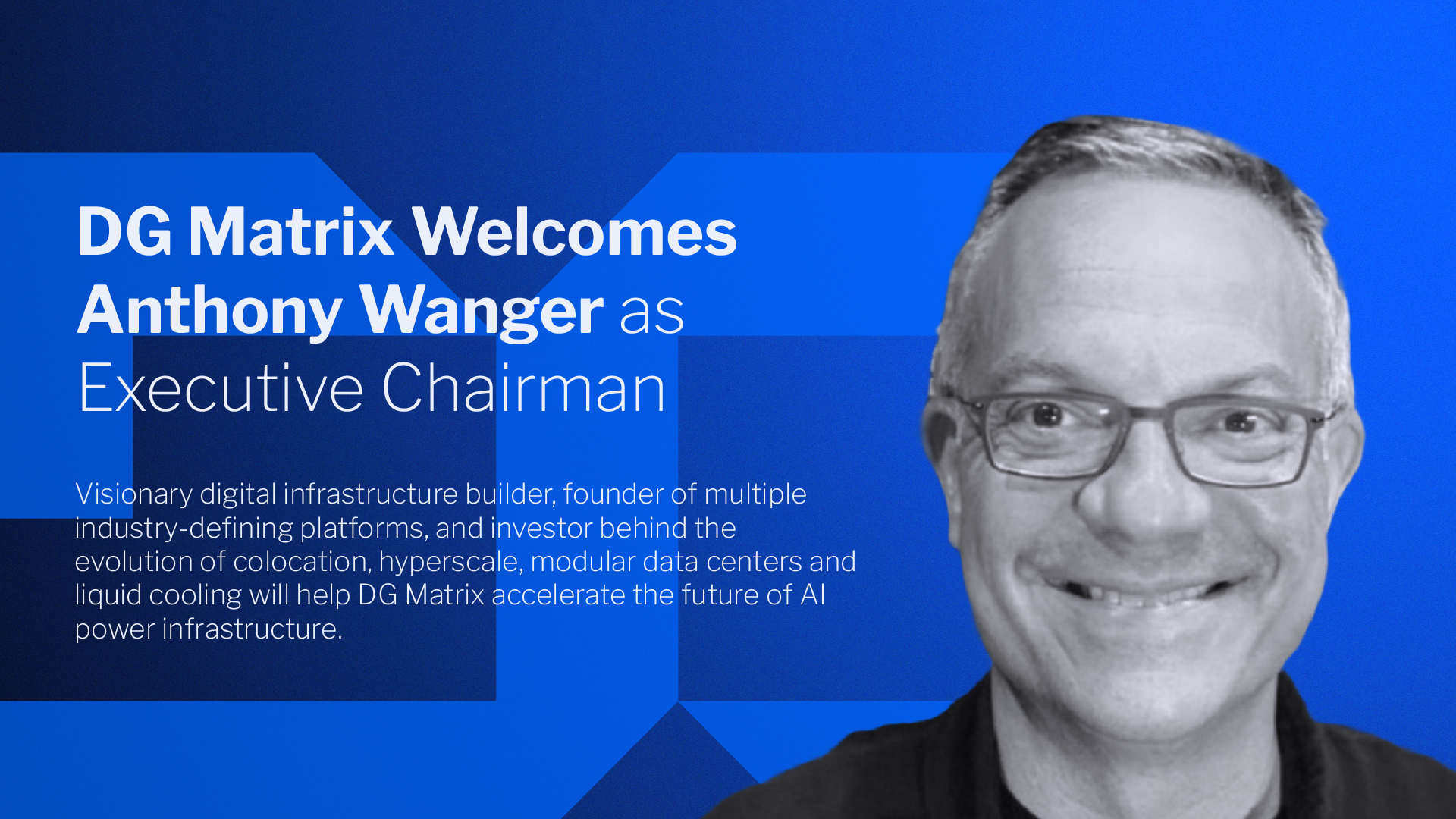
Entrepreneur and investor who built digital infrastructure platforms across every major change in the data center industry, from colocation to hyperscale, modular design and liquid cooling, will help DG Matrix build the power fabric for the AI data center. MORRISVILLE, N.C.--(BUSINESS WIRE) -- DG Matrix, the global leader in solid-state transformer solutions, today announced the appointment of Anthony Wanger, a digital infrastructure entrepreneur, executive and investor, as its first Executive Chairman. Wanger will work alongside CEO Haroon Inam and the company’s board, engineering, solutions and commercial teams as DG Matrix builds the power fabric for the Intelligence Age, the software- and AI-driven control layer that manages every watt flowing from the utility service through on-site generation, storage and power conversion and protection into the GPU. Wanger’s career is distinguished by the early identification of structural shifts in technology infrastructure and the building of platforms to capitalize on them. For more than two decades, he has developed global digital infrastructure businesses, generating billions of dollars in value for institutional investors. He is the Founder and CEO of Regnaw Capital, LLC, a family office investing in digital infrastructure and growth-stage technology markets. He has established a consistent record of market leadership at each major inflection point in digital infrastructure. In 1999, well in advance of enterprise colocation emerging as a mainstream asset class, he developed a vacant Phoenix industrial property into a carrier-grade colocation and telecommunications platform that was acquired by Digital Realty Trust for $180 million in 2006. In 2007, he co-founded IO Data Centers, where, as founder and president, he directed the company’s expansion across North America, Europe and Asia, pioneering high-efficiency, high-density data center design that anticipated the power density and thermal management requirements now defining modern AI infrastructure. Wanger identified the shift toward modular infrastructure early, co-founding BASELAYER as one of the first companies to commercialize prefabricated, modular data center technology, which was acquired by IE Corp. in 2021. From 2021 to 2024, he served as an Industry Advisor and Co-Investor with Kohlberg Kravis Roberts & Co. L.P. (“KKR”), contributing to several significant digital infrastructure transactions, including the multi-billion-dollar take-private of CyrusOne. Having identified liquid cooling as an emerging constraint at the intersection of AI scaling and data center power density, he was instrumental in KKR’s 2023 acquisition of CoolIT Systems, where, as Executive Board Member and Special Advisor, he helped reposition and scale the business into the hyperscale market. That process culminated in CoolIT’s pending acquisition by Ecolab, Inc. “Anthony has been years ahead of the market at every turn, from carrier-grade colocation to hyperscale, modular data centers and liquid cooling, and he has the rare ability to see where digital infrastructure is going and build the platforms that get it there,” said Haroon Inam, CEO of DG Matrix. “He understands, better than almost anyone, why 800 VDC and intelligent power conversion now sit at the center of every AI buildout, and why speed to power is speed to inference. Having Anthony as our Executive Chairman will sharpen how we build, deliver and service our solid-state transformer solutions, and accelerate our path to becoming the power fabric of the Intelligence industry.” Wanger joins as the data center industry confronts a fundamental transition in how power is delivered to compute. NVIDIA’s product roadmap and rising chip energy density are driving the transition to 800 VDC architectures, which are required to support next-generation systems such as Vera Rubin. DG Matrix’s AI-enabled Interport™ platform is built for this transition: collapsing multi-stage power conversion into a single, software-defined stage, absorbing GPU pulse loads, and actively controlling every watt flowing between the grid, on-site generation, storage, UPS and compute loads. DG Matrix operates the largest solid-state transformer engineering team of any company in the world, giving the platform a multi-year lead on SST hardware, firmware and AI-driven control software. “Innovation always comes from outside the industry, and what DG Matrix has built is a change of kind, not degree. It changes how power is routed to microprocessors,” said Anthony Wanger. “I was searching for the next great opportunity defined by scale and shortage, and DG Matrix is where power direction and routing are going.” The Executive Chairman appointment was assisted by Salamone Partners, a sector-specialist executive consulting firm focused on the leadership shaping the energy transition and next-generation infrastructure. The firm partners with venture-backed innovators, infrastructure investors and public companies to recruit executives and board leaders for companies at critical stages of growth and commercialization. About DG Matrix DG Matrix has commercialized the world’s first multi-port solid-state transformer to solve the most urgent challenges in deploying power infrastructure for AI datacenters and electrification. Its AI-enabled Interport™ platform acts as the intelligent power fabric of the data center, enabling faster deployment, lower energy costs, and software-controlled integration of all energy sources and loads — at scale, anywhere in the world. Learn more at https://www.dgmatrix.com/.
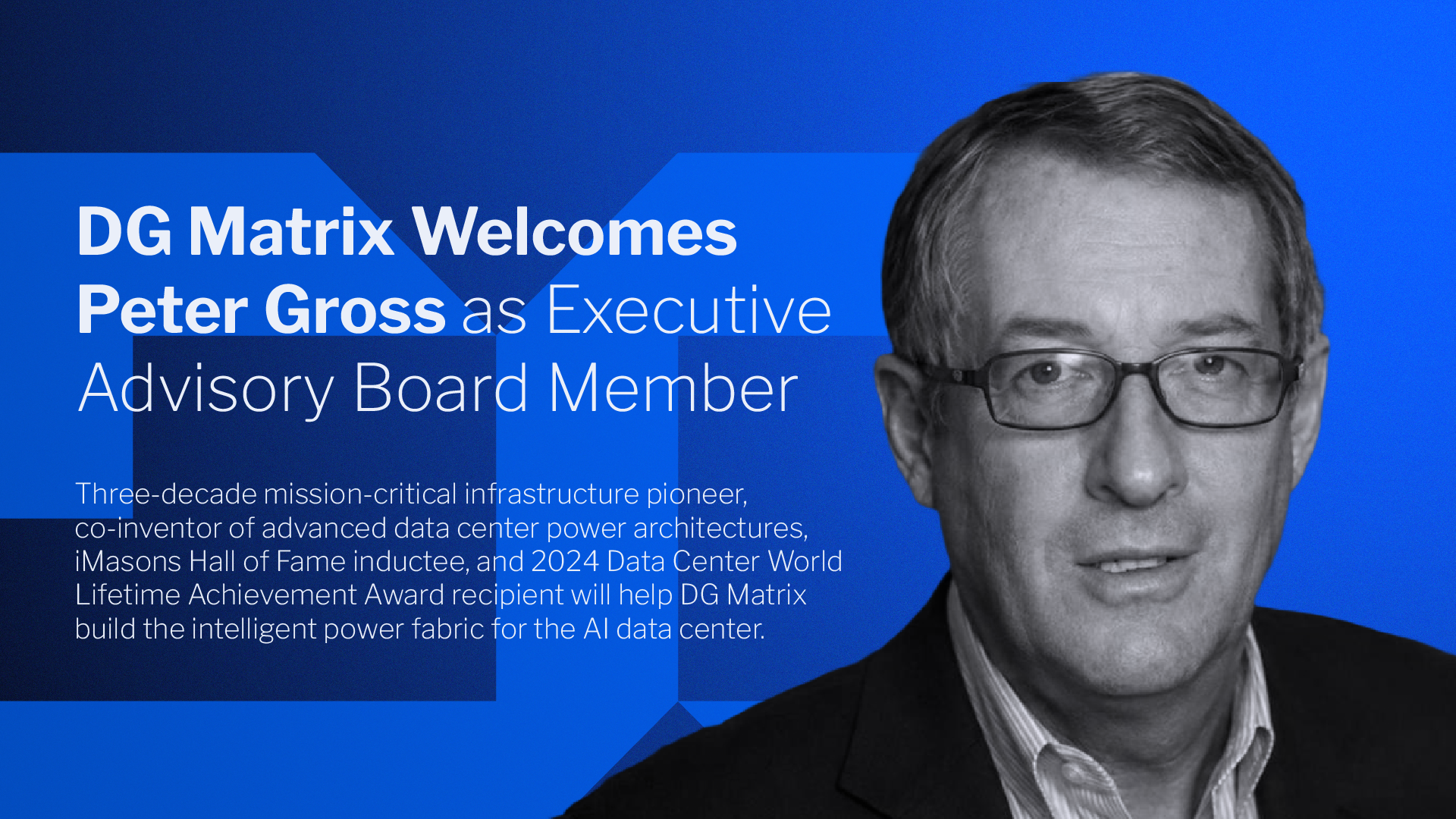
Three-decade mission-critical infrastructure leader, co-founder of EYP Mission Critical Facilities, and 2024 Data Center World Lifetime Achievement Award recipient will help DG Matrix build the intelligent power fabric for the AI data center, enabling the 800-VDC transition. RALEIGH-DURHAM, N.C., June 16, 2026. DG Matrix, the global leader in solid-state transformer solutions, today announced the appointment of Peter Gross, one of the foremost authorities on mission-critical and data center infrastructure, to its Executive Advisory Board. Gross will advise DG Matrix’s engineering, solutions, and commercial teams as the company builds the AI datadcenter intelligent power fabric: the AI-driven control layer that manages every watt flowing from a combination of utility + on-site generation and storage sources to IT loads. Gross has spent more than three decades at the forefront of mission-critical information, communication, and infrastructure design. He is currently Managing Partner of PMG Associates, a consulting and advisory firm, and until 2019 led the Mission Critical Systems group at Bloom Energy, a leading manufacturer of solid oxide fuel cells. Earlier, he co-founded and served as CEO of EYP Mission Critical Facilities, a premier data center design and engineering firm acquired by Hewlett-Packard in 2008, where he went on to lead HP’s Consulting Services focused on carbon, power, and critical facilities. A recognized thought leader in high-reliability design, power quality, energy systems and sustainability, Gross is a co-inventor on patents covering modular, prefabricated FlexDC systems, direct current power distribution topologies for data centers, and fuel-cell-based data center architectures. A Senior Member of the IEEE and a Registered Professional Engineer, he contributed to IEEE Standard 3006.7-2013 for determining the reliability of 24/7 power systems. His honors include the 2024 Data Center World Lifetime Achievement Award, the 2010 Data Center Dynamics “Outstanding Contribution to the Industry” Award, and induction into the Infrastructure Masons Hall of Fame. “Peter has shaped how the world’s most demanding data centers are designed, powered, and operated for the better part of three decades,” said Haroon Inam, CEO of DG Matrix. “He understands, better than anyone, why AI has fundamentally changed the data center and why on-site generation, grid support, and intelligent power conversion now sit at the center of every buildout. Having him on our Executive Advisory Board will sharpen how we build, deliver, and service our solid-state transformer solutions and will accelerate our path to becoming the intelligent power fabric of the industry.” Gross’s recent work has centered on the shift from AI training to inference and what it demands of digital infrastructure. Inference workloads require far higher availability, sit closer to urban load centers, and run in smaller, often co-located facilities where power can swing from full load to near zero in milliseconds. DG Matrix’s AI-enabled Interport™ platform is built to manage exactly these conditions: collapsing multi-stage power conversion into a single, software-defined stage, absorbing GPU pulse loads, and integrating on-site generation, storage and batteries into the load. Its multi-port converter can also inject reactive power back into the grid when load swings threaten to collapse grid voltage, giving operators a tool for demand response and frequency support. DG Matrix operates the largest solid-state transformer engineering team of any company in the world, giving the platform a multi-year lead on SST hardware, firmware and AI-driven control software. “For most of my career, data center power improved incrementally and nothing fundamental changed. AI changed that,” said Peter Gross. “Density has gone from a few kilowatts to as much as 500 kilowatts per cabinet, power fluctuations are severe, and on-site generation has become vital to how these facilities get built. DG Matrix has the ability to streamline the entire electrical topology, reduce footprint and cost, and protect both the load and the grid. I am convinced this technology will have a very significant impact on the industry, and that is why I am joining.” Gross serves as Chairman of Cato and sits on the boards of Aligned Data Centers, Edgevana, Apolo Cloud, Overwatch, and IDCA. He chairs the advisory councils of Vertiv and Bloom Energy and advises EnerSys, Lancium, Crusoe, VIER and Rehlko. He is an External Advisor to Bain & Company, a Master of Infrastructure Masons, and serves on the advisory boards of the UCLA Institute of the Environment and Sustainability and the Data Center Systems Engineering Board of Advisors at Southern Methodist University’s Lyle School of Engineering. As a member of the DG Matrix Executive Advisory Board, Gross will advise on platform and solutions strategy, on-site generation and grid integration, and deployment architectures for AI data center developers. His appointment continues a series of Executive Advisory Board appointments and comes as DG Matrix accelerates pilot deployments of its AI-enabled Interport platform with hyperscale, neocloud and colocation customers worldwide. About DG Matrix DG Matrix has commercialized the world’s first multi-port solid-state transformer to solve the most urgent challenges in deploying power infrastructure for AI datacenters and electrification. Its AI-enabled Interport™ platform acts as the intelligent power fabric of the data center, enabling faster deployment, lower energy costs, and software-controlled integration of all energy sources and loads, at scale, anywhere in the world. Learn more at https://www.dgmatrix.com/.
Solid State Transformers Could Reshape AI Infrastructure VC Firms Pour $280 Million Into Startups Heron Power, DG Matrix and Amperesand Three companies building next-generation power conversion technology have raised a combined $280 million in the past year, while another has been acquired by a major power vendor. These deals anticipate that the solid-state transformer (SST) will play a key role in the next phase of the AI buildout. The transformer, a device whose core design dates to the 19th century, is giving way to software-defined power electronics that are purpose-built for the AI era. The SST is emerging as a critical piece of the transition to 800 VDC power distribution, the architecture that NVIDIA and its partners are driving for next- generation AI infrastructure. SSTs also have the potential to help address “speed to power” for AI data center campuses, which face delays in the transformer supply chain. The numbers tell part of the story: Heron Power closed a $140 million Series B in February 2026, co-led by Andreessen Horowitzʼs American Dynamism Fund and Breakthrough Energy Ventures. DG Matrix closed a $60 million Series A the same month, led by Engine Ventures with participation from Mitsubishi Heavy Industries, ABB, and others, bringing total capital raised to over $100 million. Amperesand raised an $80 million Series A in November 2025, co-led by Walden Catalyst Ventures and Temasek, targeting 30 megawatts of commercial deployments in 2026. Eaton completed its acquisition of Austin-based Resilient Power Systems in August 2025, bringing medium-voltage SST technology into one of the worldʼs largest power management companies. Meanwhile, two other public companies, Enphase Energy and SolarEdge, have recently launched SST offerings specifically targeting AI data centers. The common thread: the traditional transformer cannot keep pace with the speed, density, and power scale that AI infrastructure now demands. “The transformer hasnʼt fundamentally changed in 100-plus years,” said Haroon Inam, Founder & CEO, DG Matrix. “Copper or aluminum windings around a steel core, likely oil-filled, built for a single purpose. That works when a server rack pulls 5 kilowatts and a workload is predictable. “It doesnʼt work when a single NVIDIA MGX rack demands 600 kilowatts, swings from idle to full load in microseconds, and sits behind a grid interconnection queue thatʼs three to five years long.” For the data center sector, SSTs are an emerging technology currently moving from the lab and pilot work into prototypes and first commercial offerings. Broad deployment will require operator comfort at data-center scale. But the AI boom offers a compelling opportunity for SST specialists, and investors and equipment vendors are paying full attention. Hereʼs a deep dive into SSTs and the leading companies and supporting players in the STT ecosystem. Why Solid-State Transformers Matter A solid-state transformer (SST) replaces traditional windings and cores with power semiconductors, primarily silicon carbide (SiC) or gallium nitride (GaN) devices, and software-defined control logic. The SST converts voltage like a conventional transformer, but also routes power from multiple sources simultaneously, responds to load changes in milliseconds, integrates battery backup without separate UPS hardware, and provides real-time grid stabilization. The physical difference is significant. SST-based systems can reduce electrical equipment footprint by 70 to 80 percent, eliminating layers of switchgear, distribution transformers, and UPS systems that a conventional data center power chain requires. By supporting multiple ports, they are also ideal for microgrid integrations that combine generation sources. “Too much of todayʼs electrical infrastructure is passive, clunky equipment designed decades ago,” said Drew Baglino, Founder and CEO of Heron Power. “We need new, more capable solutions to keep pace with accelerating energy demand and the rapid growth of gigascale compute.” Addressing Data Center Bottlenecks The data center power problem has two distinct layers. The first is speed to power. Utility power constraints are creating lengthy grid interconnection timelines, while lead times for medium- and high-voltage transformers can now run 18 to 36 months. SSTs can address this directly by collapsing procurement and installation timelines, and in some architectures can connect directly to medium-voltage distribution grids without a traditional transformer layer. The second is density: getting power to the rack efficiently once it arrives. AI workloads have pushed rack power requirements past 100 kilowatts (kWs), with NVIDIAʼs Rubin Ultra platform targeting up to 600 kilowatts per rack. The conventional 54-volt DC in-rack distribution architecture hits hard physical limits at those densities. AI training loads add a third wrinkle: a GPU cluster can swing from idle to full power in seconds. SSTs with integrated energy storage absorb those load spikes at the rack level, protecting both the facilityʼs internal distribution and the wider grid.The data center power problem has two distinct layers. The first is speed to power. Utility power constraints are creating lengthy grid interconnection timelines, while lead times for medium- and high-voltage transformers can now run 18 to 36 months. SSTs can address this directly by collapsing procurement and installation timelines, and in some architectures can connect directly to medium-voltage distribution grids without a traditional transformer layer. The second is density: getting power to the rack efficiently once it arrives. AI workloads have pushed rack power requirements past 100 kilowatts (kWs), with NVIDIAʼs Rubin Ultra platform targeting up to 600 kilowatts per rack. The conventional 54-volt DC in-rack distribution architecture hits hard physical limits at those densities. AI training loads add a third wrinkle: a GPU cluster can swing from idle to full power in seconds. SSTs with integrated energy storage absorb those load spikes at the rack level, protecting both the facilityʼs internal distribution and the wider grid. The 800 VDC Transition NVIDIA is working with more than 20 AI infrastructure providers, including CoreWeave, Lambda, Nebius, and Oracle Cloud Infrastructure, to design data centers built around 800-volt direct current power distribution, or 800 VDC. The target platform is NVIDIAʼs Rubin Ultra GPU generation, expected in 2027, which will support rack densities up to 600 kilowatts. Todayʼs AI clusters run at roughly 120 kilowatts per rack. Moving to 800 VDC eliminates most of the intermediate conversion steps in the power chain, with NVIDIA projecting up to a 5 percent improvement in end-to-end power efficiency, a 70 percent reduction in maintenance costs from fewer power supply unit failures, and a meaningful reduction in cooling load by eliminating AC/DC conversion hardware inside the racks. “800 VDC fixes the architecture, not just the voltage,” said Inam of DG Matrix. “By taking the data center to DC at the row, or ideally at the building, operators eliminate the rectifier-inverter conversion step entirely. NVIDIAʼs MGX reference design recognizes this, which is why they are standardizing 800 VDC across the ecosystem. The end goal is achieving 34.5kV AC to 800V DC power conversion, creating a simplified pathway from grid to rack, with native per-rack 800V DC outputs aligned to industry reference designs. That single-step conversion from medium-voltage grid power to rack-ready 800 VDC is the architectural move outlined in NVIDIAʼs blueprint. “As data centers approach gigawatt-scale campuses built around megawatt AI compute racks, they are rightfully taking inspiration from mature gigascale DC technologies like energy storage and solar,” said Baglino of Heron Power. “Direct 34.5kV AC to 800V DC conversion is the efficient, streamlined, scalable power architecture that global leaders in AI need to achieve their goals.” That said, NVIDIA has noted that deploying 800 VDC at the facility level introduces new challenges in safety, standards, and workforce training, and that the transition will occur in phases. The first phase of the 800 VDC transition is expected to feature “sidecar” racks installed alongside compute racks, enabling denser GPU and CPU racks while separating out power components for 800 VDC conversion. Full-scale production is tied to the 2027 Kyber rack rollout, and the neoclouds optimizing for NVIDIAʼs AI factory designs are likely to move first. The SST Data Center Ecosystem Hereʼs a look at the leading companies developing SSTs and the supporting ecosystem. NOTE: We will discuss some public companies in this section. The information provided here is for informational and educational purposes only, and does not constitute investment advice or any other professional advice. Please consult with a professional for specific advice tailored to your situation. DG Matrix DG Matrix is the pacesetter in productizing solid-state transformers for data center use. It has developed the Interport SST platform, which routes power from multiple sources simultaneously to multiple loads at differing voltages. The company says the Interport platform is “purpose-built” to integrate with the NVIDIA MGX modular rack architecture to deliver 800 VDC to GPU racks. DG Matrix has also conducted a yearlong program of testing energy storage solutions for dynamic GPU load response in collaboration with NVIDIA. “This is a pivotal moment for the industry,” said Inam. “Our multi-port capability enables integrated behind-the-meter power aggregation from multiple AC and DC sources along with simultaneous AC and DC outputs, offering a future-proofed platform today.” Three partnerships reinforce the companyʼs commercial momentum. DG Matrix just announced a strategic partnership with modular developer InfraPartners, which will pair its prefabricated data centers with the DG Matrix Interport 360 to create a “grid-to-rack” power management solution. Exowatt, the renewable energy startup backed by a16z and Sam Altman, selected Interport as its preferred power conversion platform for gigawatt-scale solar data center builds. See our podcast episode with Exowatt for more on its technology. DG Matrix PowerSecure has formed a strategic collaboration with DG Matrix for AI data center and electrification deployments. DG Matrix has installed a working pilot at Exowatt, and says it is shipping production units for other customers for multiple use cases. “We are working with hyperscalers, energy companies, and industrial customers across North America and globally, with multiple gigawatt-class data centers in the pipeline,” said Inam. The company recently got a vote of confidence from data center pioneer Christian Belady, who joined as an advisor. “AI has rewritten the power requirements of a data center,” said Belady. “DG Matrix has built the first commercially available multi-port solid-state transformer by collapsing the data center electrical system of discrete devices into a single device … That is the kind of architectural shift the industry needs.” The company is a privately-held, VC-backed startup. Investors in DG Matrix include ABB, which is also a legacy transformer incumbent, another signal that established power players are engaging with SST innovation. Heron Power Heron Power was founded by Baglino, former SVP of Powertrain and Energy at Tesla, where he led development of the Powerwall and Megapack and the buildout of a 50 GWh battery factory. That manufacturing scale-up experience is directly relevant to what Heron is attempting: not just a new product, but a new product category at industrial volume. Heron Link converts medium-voltage AC, including 34.5 kV distribution, directly to 800 VDC in a single conversion step, natively compatible with NVIDIA's 800 VDC rack architecture. Each unit handles up to 4.2 megawatts and includes integrated battery storage that can eliminate the need for separate UPS systems. NVIDIA has recognized Heron as a data center power system provider within its Open Innovation Ecosystem. Heron recently shared its blueprint for 800 VDC data centers outlining its strategy for supporting Kyber racks. “At Heron we are manifesting an alternative future, where modern power electronics enable projects to come online faster, the grid to operate more reliably, and scale affordably,” said Baglino. The companyʼs $140 million Series B funding provides resources for building a 40 GW per year U.S. manufacturing facility. Internal field demonstrations are expected mid- 2026, with partner installations in early 2027 and manufacturing ramp through 2028. Amperesand Amperesand was spun out of Singaporeʼs Nanyang Technological University and Temasekʼs Xora Innovation following years of SiC power electronics research, and has built a leadership team with deep experience in large-scale power systems. The company initially focused on decarbonization for ports and industrial customers, but says it also is targeting the huge market for data center power infrastructure. Its medium voltage SST platform consolidates medium-voltage transformers, switchgear, and UPS systems into a single factory-built product. The companyʼs oversubscribed $80 million Series A closed with new investors including Industry Ventures, Acclimate Ventures, and SG Growth Capital alongside continuing backers. First commercial units are being delivered this year to the Port of Singapore in collaboration with PSA International, and the company says it has multiple pilots with undisclosed hyperscale AI data center operators. Eaton / Resilient Power Systems Eatonʼs acquisition of Resilient Power Systems, completed in August 2025, brings institutional manufacturing scale and a global field service organization to medium- voltage SST technology. Resilientʼs initial product connected EV charging depots directly to distribution grids. Data centers are the next application. “Resilientʼs innovative technology, offering high density electrical power in a smaller footprint than comparable solutions,” said Heath Monesmith, President and COO of Eatonʼs Electrical Sector. “We are excited for the opportunity to scale this next- generation medium voltage solid-state transformer technology for growing global markets like data center and energy storage.” Eatonʼs Q2 2025 investor materials described the Resilient acquisition as strengthening its power distribution offering for data centers and called SST technology “a critical building block in future high-power AI data center designs.” What Eaton (NYSE:ETN) brings is what the startups lack: customer relationships with utilities and large enterprises, and manufacturing scale. Enphase Energy The most recent major entrant is Enphase Energy. On April 28, the residential solar microinverter leader announced development of the IQ Solid-State Transformer, saying it was purpose-built for AI data centers. The IQ SST deploys a “supercluster” of 342 intelligent power modules, which use GaN switching rather than SiC. The system converts medium-voltage AC directly to 800 VDC or ±400 VDC in a single stage, with 98.5 percent targeted efficiency and 99.999 percent availability through distributed redundancy. “AI is changing how power must be delivered to compute infrastructure,” said Badri Kothandaraman, President and CEO of Enphase (Nasdaq: ENPH). “For two decades, Enphase has built distributed, semiconductor- and software-defined power conversion systems at scale. As AI racks move toward 800 VDC architectures and megawatt-scale densities, we see a large opportunity to apply this expertise to data center power infrastructure.” The companyʼs timeline calls for full system demonstrations in late 2026, customer pilots in 2027, and volume shipments in 2028. SolarEdge Technologies In November 2025 SolarEdge announced a collaboration with Infineon Technologies to develop a modular 2 to 5 MW SST for AI and hyperscale data centers. The joint development targets greater than 99 percent conversion efficiency and direct medium-voltage to 800 to 1500 VDC conversion, combining SolarEdgeʼs DC architecture expertise with Infineonʼs SiC switching technology. “The AI revolution is redefining power infrastructure,” said Shuki Nir, CEO of SolarEdge (Nasdaq:SEDG). “Collaborating with Infineon brings world-class semiconductor innovation to our efforts to build smarter, more efficient energy systems for the AI era.” SolarEdge followed in March 2026 with a published roadmap report arguing that legacy AC-based data center power systems may soon be unable to support accelerating compute density. The company has begun engaging with potential customers but has not specified commercial timelines. For more on SolarEdge, hereʼs our Data Center Richness podcast episode with Dafna Granot, the Senior Manager for Strategy & Innovation at SolarEdge. Delta Electronics Delta Electronics has the most tangible proof point in the field: a production SST deployment in an operating AI data center. In February 2026, Deltaʼs SST system went live at a Chindata Group hyperscale campus in North China, installed for internet platform company Meituan. Delta says its SST system employs a modular design, with a single power cabinet delivering up to 1 MW while occupying just one square meter, offering a 50% space savings compared with conventional solutions. Deltaʼs system uses proprietary solid insulation technology and SiC power conversion to deliver multi-level DC outputs of 240V, 400V, and 800V. Meituan, Chindata, and Delta jointly conducted technical research and development and ultimately decided to deploy Deltaʼs indoor-type SST system. “During the process of implementing innovation, we faced multiple challenges,” said Xin-Ping Ye, Product Marketing Director of the ICT Infrastructure Department, Delta GreenTech China, who said the teams “custom-engineered an intelligent power-delivery architecture featuring high power density and multi-voltage outputs.” At NVIDIA GTC in March 2026, Delta also showcased 800 VDC in-row power racks developed in collaboration with NVIDIA. Hitachi, Siemens, Schneider Electric,Vertiv Hitachi Energy, Siemens, Schneider Electric and Vertiv all maintain active SST research programs targeting data centers, though none has announced a commercially available product. All four companies are partners in NVIDIAʼs Omniverse DSX initiative and are expected to be players in the 800 VDC transition. It remains to be seen whether these companies will offer their own solution, partner, or follow Eatonʼs strategy and enter the SST market through acquisition. Vertiv and Schneider each have a long history of acquiring promising providers in data center infrastructure. The Semiconductor Layer Conventional power electronics run on silicon. Solid-state transformers depend instead on wide-bandgap (WBG) materials, principally silicon carbide (SiC), with gallium nitride (GaN) in a growing supporting role. “Bandgap” refers to the energy required to push electrons into conduction. As a wide-bandgap material, SiC handles higher voltages, higher temperatures, and faster switching than traditional silicon. That matters because faster switching at higher frequencies lets SST designs shrink their magnetic components and shed heat, with lower switching and conduction losses. In practice, SiC tends to carry the medium-voltage front end where utility power first enters, while GaN is strongest in the lower-voltage, high-frequency conversion stages closer to the load. For power-semiconductor makers, the business opportunity is supplying the medium- and high-voltage SiC (and GaN) that make SSTs and the wider HVDC chain viable. Their approaches diverge: some sell devices into third-party SST integrators, others push a flagship high-voltage part as the enabling technology, and all anchor their positioning to NVIDIA's roadmap. Semiconductor Providers for SSTs Infineon Technologies is a global leader in power semiconductors. Its CoolSiC line anchors a portfolio that spans silicon, silicon carbide, and gallium nitride. Infineonʼs strategy is to be the default component and subsystem supplier sitting underneath multiple competing SST designs. In March 2026 it partnered with DG Matrix, which will source the latest SiC for its Interport platform. It is also working with SolarEdge on a modular 2-to-5 MW SST building block, targeting greater than 99% efficiency for 800 VDC data centers. In September 2025 it signed an agreement with ROHM to collaborate on SiC products used in AI data centers. Navitas Semiconductor (Nasdaq:NVTS) is a wide-bandgap power specialist built on GaNFast gallium nitride and GeneSiC silicon carbide. Navitas holds the most visible customer endorsement in the SST value chain, having been named a collaborator on NVIDIA's 800V HVDC architecture for the Kyber racks powering Rubin Ultra GPUs. Navitas supplies high-voltage SiC for the grid-to-800V conversion stage, including SSTs, and GaN for downstream rack delivery, and positions itself as an enabler embedded in NVIDIA's roadmap rather than an SST integrator in its own right. Wolfspeed - This companyʼs role in the SST value chain rests on its high-voltage silicon carbide, headlined by the industry's first commercially available 10 kV SiC MOSFET aimed squarely at the medium-voltage grid interface that NVIDIA's 800 VDC vision depends on, now backed by new 3.3 kV modules. Having emerged from a 2025 Chapter 11 restructuring that cut debt by about 70%, it sells device leadership while rebuilding financial credibility with customers. This month Wolfspeed (NYSE:WOLF) launched a dedicated data center solutions team and regional office in the Bay Area. onsemi (ON Semiconductor, Nasdaq:ON) frames its role across the entire SST and HVDC chain, from substation conversion down to the processor, listing solid-state transformers explicitly among its targets and collaborating with NVIDIA on the 800 VDC transition on the strength of decades of silicon and EliteSiC. It aims to be a broad systems supplier across the chain rather than a single-stage SST specialist.
End-to-end “grid-to-rack” solution accelerates time-to-compute and reduces deployment risk for next-generation AI workloads HOUSTON, Texas and MORRISVILLE, N.C., May 27, 2026 — InfraPartners , a leader in prefabricated, upgradeable AI data center solutions, and DG Matrix , a global pioneer in solid-state transformer solutions, today announced a strategic partnership to deliver an industry-first end-to-end AI infrastructure platform integrating AI Factory deployment with a globally-standardized, software-defined power architecture. The platform addresses one of the most critical constraints facing AI growth today: the ability to deploy power and infrastructure globally at the speed required to meet accelerating demand. By integrating InfraPartners RapidNode: a prefabricated, Upgradeable Data Center™, with DG Matrix’s Interport 360™, InfraPartners and DG Matrix enable a true “grid-to-rack” solution designed to accelerate time-to-compute and support evolving AI technologies and workload transitions. At a time when power availability and deployment timelines are limiting AI expansion, the platform enables operators to standardize deployments globally, reduce engineering and supply chain complexity, and reduce the risk of infrastructure obsolescence as GPU and power architectures rapidly evolve. “AI demand is not being constrained by access to compute, but by how quickly we can deliver the infrastructure to support it,” said Michalis Grigoratos, CEO of InfraPartners. “By integrating prefabricated AI Factory deployment with DG Matrix’s software-configurable power fabric, we are removing one of the biggest bottlenecks in the market. This partnership creates a faster, more flexible path to AI compute, enabling our customers to scale with confidence while protecting long-term infrastructure investments.” DG Matrix’s Interport 360™ introduces the world’s fastest, most flexible approach to data center power infrastructure. The standardized power platform can be deployed in any location, with any power sources, for any data center architecture. Software-defined functionality optimizes power and compute in real time to optimize token outputs and energy costs alongside grid interactivity to accelerate interconnection. Designed to support both AC and DC architectures, including emerging 800-VDC standards, the platform enables operators to transition between architecture standards without costly redesigns. Combined with InfraPartners’ Upgradeable Data Center™ architecture, the result is a future-ready system that evolves alongside AI technology cycles. “Power infrastructure must become as adaptable as the compute it supports,” said Haroon Inam, CEO of DG Matrix. “Our partnership with InfraPartners brings together two complementary innovations to deliver a fully integrated platform that is configurable, scalable, and globally deployable. Together, we are enabling AI operators to overcome power constraints, reduce deployment risk, and unlock new levels of performance and efficiency.” InfraPartners and DG Matrix have also released an executive white paper titled, ‘ The First End-to-End, AI-Ready Power + AI Factory Platform ’ detailing the architecture, deployment model, and economic impact of the platform. The integrated platform delivers a comprehensive set of capabilities, including prefabricated AI Factory infrastructure, native AC/DC-compatible power architecture, integrated energy management, and real-time optimization across power and compute workloads. By combining standardized design with software configurability, the solution reduces engineering complexity, shortens deployment timelines, and mitigates supply chain risk. About InfraPartners InfraPartners is a global leader in digital infrastructure, delivering scalable, future-proof data center solutions. The company’s standardized design process and offsite manufacturing offer greater schedule and cost certainty, plus rigorous quality control. InfraPartners collaborates with hyperscalers, colocation providers, GPU-as-a-Service (GPUaaS) providers, and government entities to design and deploy AI-ready data centers. For more information, visit https://infrapartners.llc . About DG Matrix DG Matrix has commercialized the world’s first multi-port solid-state transformer to solve the most urgent challenges in deploying power infrastructure for AI data centers and electrification. Its standardized Interport platform enables faster deployment, lower energy costs, and flexible integration of all energy sources and loads—at scale, anywhere in the world.
AI-Ready Power Infrastructure for Faster AI Factory Deployment Artificial intelligence is driving unprecedented demand for compute infrastructure, but power availability and deployment speed have become the biggest barriers to AI factory expansion. This white paper introduces an end-to-end AI-ready platform that combines intelligent power infrastructure with modular AI factory deployment to reduce implementation timelines and improve operational efficiency. Grid-to-Rack Architecture with Interport™ Multi-Port Solid-State Transformer (SST) The paper explains how the DG Matrix Interport™ platform integrates software-defined power, multi-port solid-state transformer (SST) technology, and AI-ready electrical architecture into a standardized "grid-to-rack" solution. It demonstrates how organizations can reduce deployment complexity while supporting future GPU generations and evolving power architectures. Reducing Time-to-Compute with Software-Defined Power Systems Organizations investing in AI infrastructure need solutions that accelerate time-to-compute while minimizing deployment risk. This white paper provides a blueprint for scalable AI factories capable of supporting hyperscale, enterprise, and cloud AI environments through intelligent power management. Tags AI Factory AI-Ready Power Grid-to-Rack Architecture Interport Multi-Port Solid-State Transformer (SST) Software-Defined Power AI Data Centers Time-to-Compute GPU Infrastructure Modular AI Factory
Read the full coverage: https://www.edn.com/power-electronics-evolve-to-maximize-efficiency/
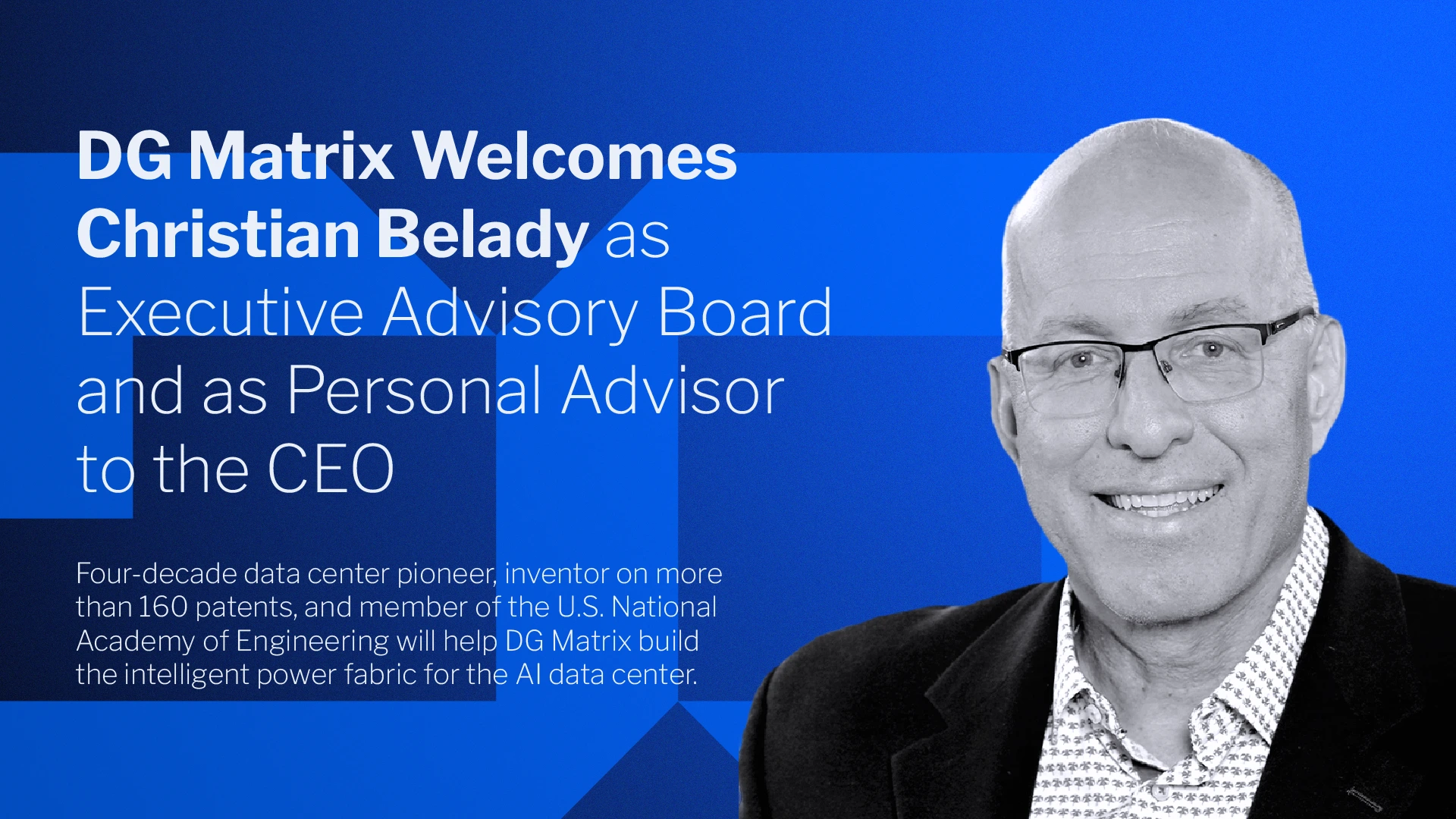
Four-decade data center pioneer, inventor on more than 160 patents, and member of the U.S. National Academy of Engineering will help DG Matrix build the intelligent power fabric for the AI data center. RALEIGH-DURHAM, N.C. -- DG Matrix, the global leader in solid-state transformer solutions, today announced the appointment of Christian Belady, one of the most influential figures in the modern data center industry, to its newly formed Executive Advisory Board. Belady will also serve as a personal advisor to DG Matrix CEO Haroon Inam and work directly with the company’s engineering, solutions and commercial teams as DG Matrix builds the intelligent power fabric for the AI data center — the software- and AI-driven control layer that manages every watt flowing from the utility service through on-site generation, storage and power conversion & protection into the GPU. Belady has spent more than four decades in the data center industry and is an inventor on more than 160 patents. He spent 16 years at Microsoft, where he served as a Distinguished Engineer. In 2023, he retired from Microsoft after 16 years as Vice President and Distinguished Engineer of Data Center Research and Development in the company’s Cloud Infrastructure Organization where he pioneered innovations in data center cooling and on-site power generation. For a decade prior, he led worldwide data center development across site selection, energy, engineering, construction and operations. Belady originated the Power Usage Effectiveness (PUE) metric while at Hewlett Packard — a metric that has defined how the industry measures data center efficiency for two decades. He later co-authored Water Usage Effectiveness (WUE) and Carbon Usage Effectiveness (CUE) with The Green Grid, and has shaped standards work at ASHRAE and other industry bodies. His contributions have materially improved global data center energy efficiency over the past 20 years. “Christian wrote the rulebook for how modern data centers are designed, sited and measured,” said Haroon Inam, CEO of DG Matrix. “He has been warning the industry for years that power is the binding constraint on cloud and AI growth, and that data centers need a power intelligence layer to match AI compute. Having him on our Executive Advisory Board and at my side as a personal advisor will sharpen how we build, deliver and service our solid-state transformer (SST) solutions — and accelerate our path to becoming the intelligent power fabric of the industry.” Belady’s recent work has centered on the intersection of AI infrastructure, grid interconnection and the power fabric inside the data center — how power is converted, routed, controlled and delivered from the utility service to the GPU. DG Matrix’s AI-enabled Interport™ platform is built to become that fabric: collapsing multi-stage power conversion into a single, software-defined stage, absorbing GPU pulse loads, and actively controlling every watt flowing between the grid, on-site generation, storage, UPS and compute loads. DG Matrix also operates the largest solid-state transformer engineering team of any company in the world, giving the platform a multi-year lead on SST hardware, firmware and AI-driven control software. “AI has rewritten the power requirements of a data center,” said Christian Belady. “Speed to inference is now speed to power. DG Matrix has built the first commercially available multi-port solid-state transformer by collapsing the data center electrical system of discrete devices into a single device just as semiconductor integrated circuits did with transistors, capacitors and resistors in the 1960s enabling hardware into a software- and AI-driven control layer for the data center power. That is the kind of architectural shift the industry needs, and it is why I am joining. I want to help this team transform data center design and delivery to energize in months rather than years… if not sooner!” Since leaving Microsoft, Belady has served as an advisor and board member to several of the most prominent firms in digital infrastructure. He was recently elected to the U.S. National Academy of Engineering, one of the highest professional distinctions an engineer can receive. His industry recognitions include the 2017 DataCloud “Data Center Thought Leadership” Award, the iMasons “2020 Industry Luminary” Award, the 2023 Interglobix Titans List, the 2024 Northern Virginia Technology Council Data Center Icon Award, and the 2025 Data Center World Lifetime Achievement Award. As a member of the DG Matrix Executive Advisory Board, Belady will advise on platform and solutions strategy, customer engagement and modular deployment architectures for AI data center developers. His appointment is the first in a series of planned Executive Advisory Board appointments and comes as DG Matrix accelerates deployments of its AI-enabled Interport™ platform with hyperscale, neocloud and colocation customers worldwide. About DG Matrix DG Matrix has commercialized the world’s first multi-port solid-state transformer to solve the most urgent challenges in deploying power infrastructure for AI data centers and electrification. Its AI-enabled Interport platform acts as the intelligent power fabric of the data center, enabling faster deployment, lower energy costs, and softwarecontrolled integration of all energy sources and loads — at scale, anywhere in the world. Learn more at https://www.dgmatrix.com
Behind-the-Meter Power Strategies for AI Data Center Growth As AI workloads continue to grow, traditional grid expansion cannot keep pace with increasing electricity demand. This white paper explores how behind-the-meter power strategies enable organizations to deploy AI infrastructure faster while reducing dependence on lengthy utility upgrades and transmission expansion. Interport™ SST Integration of Utility Power, BESS, DERs, and Renewables The paper examines how the DG Matrix Interport™ multi-port solid-state transformer platform integrates utility power, battery energy storage systems (BESS), distributed energy resources (DERs), and renewable generation into a unified software-defined energy platform. This approach improves energy flexibility, resiliency, and utilization while supporting high-density AI workloads. Overcoming Grid Constraints with AI-Ready Energy Infrastructure Behind-the-meter energy strategies help organizations overcome grid constraints, reduce deployment delays, and improve operational resilience. The paper provides practical guidance for designing AI-ready energy infrastructure capable of supporting future computing demands. Tags Behind-the-Meter Power BTM Power AI Infrastructure AI Data Centers Interport Solid-State Transformer (SST) Battery Energy Storage Systems (BESS) Distributed Energy Resources (DERs) Renewable Generation Grid Constraints
800 VDC Power Architecture for Next-Generation AI Data Centers The transition to 800-volt direct current (800 VDC) represents one of the most significant changes in AI data center power architecture. This white paper explains how higher-voltage DC distribution improves efficiency while supporting next-generation GPU clusters and high-density computing environments. Interport™ SST for High-Voltage DC Distribution and Power Conversion The paper discusses the economic and technical benefits of migrating from traditional 48V systems to 800 VDC architectures. It highlights how the DG Matrix Interport™ platform enables intelligent power conversion, simplified electrical distribution, and seamless integration with AI-ready infrastructure. Improving Efficiency for GPU Clusters and High-Density AI Computing As AI computing power continues to increase, electrical efficiency becomes a critical competitive advantage. This white paper helps infrastructure planners understand how solid-state transformer technology supports scalable, efficient, and future-ready AI data centers. Tags 800 VDC AI Data Centers Solid-State Transformer (SST) Interport High-Voltage DC GPU Clusters Power Conversion Electrical Distribution AI Infrastructure Energy Efficiency
Financial Strategy for AI-Ready Power Infrastructure Peter Sopher, Chief Financial Officer at DG Matrix, shares his perspective on the rapid transformation of energy infrastructure driven by artificial intelligence, electrification, and digital innovation. He explains how financial strategy, technology investment, and infrastructure modernization work together to support the commercialization of next-generation power solutions, including the Interport™ multi-port solid-state transformer platform. Scaling Interport™ Multi-Port Solid-State Transformer (SST) Commercialization The article explores how AI data centers, grid modernization, and distributed energy systems are creating unprecedented demand for intelligent power infrastructure. Peter Sopher discusses the importance of scalable business models, strategic partnerships, and long-term investment in technologies that enable faster deployment, greater energy efficiency, and resilient power delivery for modern enterprises. Why AI Infrastructure Growth Requires Strategic Power Investment As organizations invest in AI infrastructure and electrification, financial leadership plays a critical role in accelerating innovation. This article highlights how DG Matrix combines technology leadership with strategic financial planning to support sustainable growth and deliver intelligent energy infrastructure for the AI era. Tags Peter Sopher CFO AI Data Centers Electrification Interport Multi-Port Solid-State Transformer (SST) Energy Infrastructure Financial Strategy Strategic Partnerships Infrastructure Modernization Software-Defined Power
Turning Stranded Electrical Capacity into AI Computing Revenue Many AI data centers secure more electrical capacity than they can effectively use because conventional infrastructure requires significant reserve margins. This white paper explains how software-defined power infrastructure transforms stranded power into usable computing capacity. Interport™ Dynamic Power Management for Utility, Battery, and DER Integration The paper demonstrates how the DG Matrix Interport™ platform dynamically manages utility power, battery storage, and distributed energy resources to absorb peak demand while maintaining grid compliance. Intelligent energy routing enables higher infrastructure utilization without requiring additional utility connections. Increasing AI Data Center Utilization Without New Utility Connections Improving power utilization directly increases AI computing capacity and revenue potential. Organizations can maximize existing electrical infrastructure while avoiding costly substation upgrades and lengthy utility interconnection processes. Tags Stranded Power AI Data Center Revenue Software-Defined Power Infrastructure Interport Dynamic Power Management Battery Storage Distributed Energy Resources (DERs) Grid Compliance Power Utilization Utility Interconnection
Veteran marketing executive brings more than 25 years of global data center brand, demand generation, and customer experience leadership from Vertiv, Schneider Electric, and APC to accelerate DG Matrix’s commercial expansion MORRISVILLE, N.C DG Matrix, the global leader in solid-state transformer solutions, today announced the appointment of Rainer Stiller as Chief Marketing Officer, effective immediately. Stiller will lead the company’s marketing organization and global go-to-market strategy as DG Matrix scales its next-generation power infrastructure platform for AI data centers and electrification. Stiller brings more than 25 years of progressive marketing and commercial leadership spanning the critical infrastructure and energy technology sectors. He began his career learning the marketing craft at BMW’s corporate headquarters in Munich, managing key customer events and product placement programs before joining APC (American Power Conversion), where he rose from regional marketing manager to Director of Worldwide Marketing Communications, driving brand awareness to record levels across global markets. Following APC’s acquisition by Schneider Electric, Stiller advanced to Senior Vice President of Global Field and Portfolio Marketing, where he launched global brand and demand generation campaigns resulting in multi-billion dollar pipeline contributions through newly deployed commercial automation systems. Most recently, as Chief Marketing Officer of Vertiv (NYSE: VRT), a $100 billion global provider of critical digital infrastructure, Stiller oversaw the transformation of the company’s marketing function. He led the brand transformation from a perceived industrial company to the undisputed leader in AI infrastructure. During his tenure at Vertiv, Stiller was recognized as a “CMO to Watch 2024” and received the PR News “2023 People of the Year — Chief Communications Officer” award, reflecting his impact on brand equity development and integrated marketing communications at the global enterprise level. At DG Matrix, Stiller will oversee customer experience, brand equity development, demand generation, and global alliance marketing as the company enters its next phase of commercial growth. His experience building high performance marketing organizations across the Americas, Europe, and Asia will be instrumental as DG Matrix expands its global footprint. “Rainer is exactly the leader we need as DG Matrix transitions from technology breakthrough to global market scale,” said Haroon Inam, CEO of DG Matrix. “His track record of building world-class demand generation engines, transforming customer experiences, and driving commercial growth at companies like Vertiv and Schneider Electric is unmatched. As we accelerate deployments of our Interport platform across AI data centers and electrification projects worldwide, Rainer’s expertise in brand development and go-to-market strategy will be a powerful catalyst for our growth.” “DG Matrix is at the forefront of solving one of the most critical infrastructure challenges of our time,” said Rainer Stiller. “The opportunity to shape the global marketing and go-to-market strategy for a company that has commercialized the world’s first multi-port solid-state transformer is truly compelling. I’m excited to join this talented team and help accelerate our reach into new markets and customer segments around the world.” Throughout his career, Stiller has transformed companies into enterprise-scale global brands, led teams of over 1,200 professionals across more than 60 countries, and built channel partner programs that expanded from 250 to 4,000 resellers in a single year. His expertise spans digital transformation, demand generation, customer and partner experience, strategic alliances, and global brand development across B2B, B2C, and B2B2C go-to-market models. About DG Matrix DG Matrix has commercialized the world’s first multi-port solid-state transformer to solve the most urgent challenges in deploying power infrastructure for AI datacenters and electrification. Its standardized Interport platform enables faster deployment, lower energy costs, and flexible integration of all energy sources and loads—at scale, anywhere in the world.
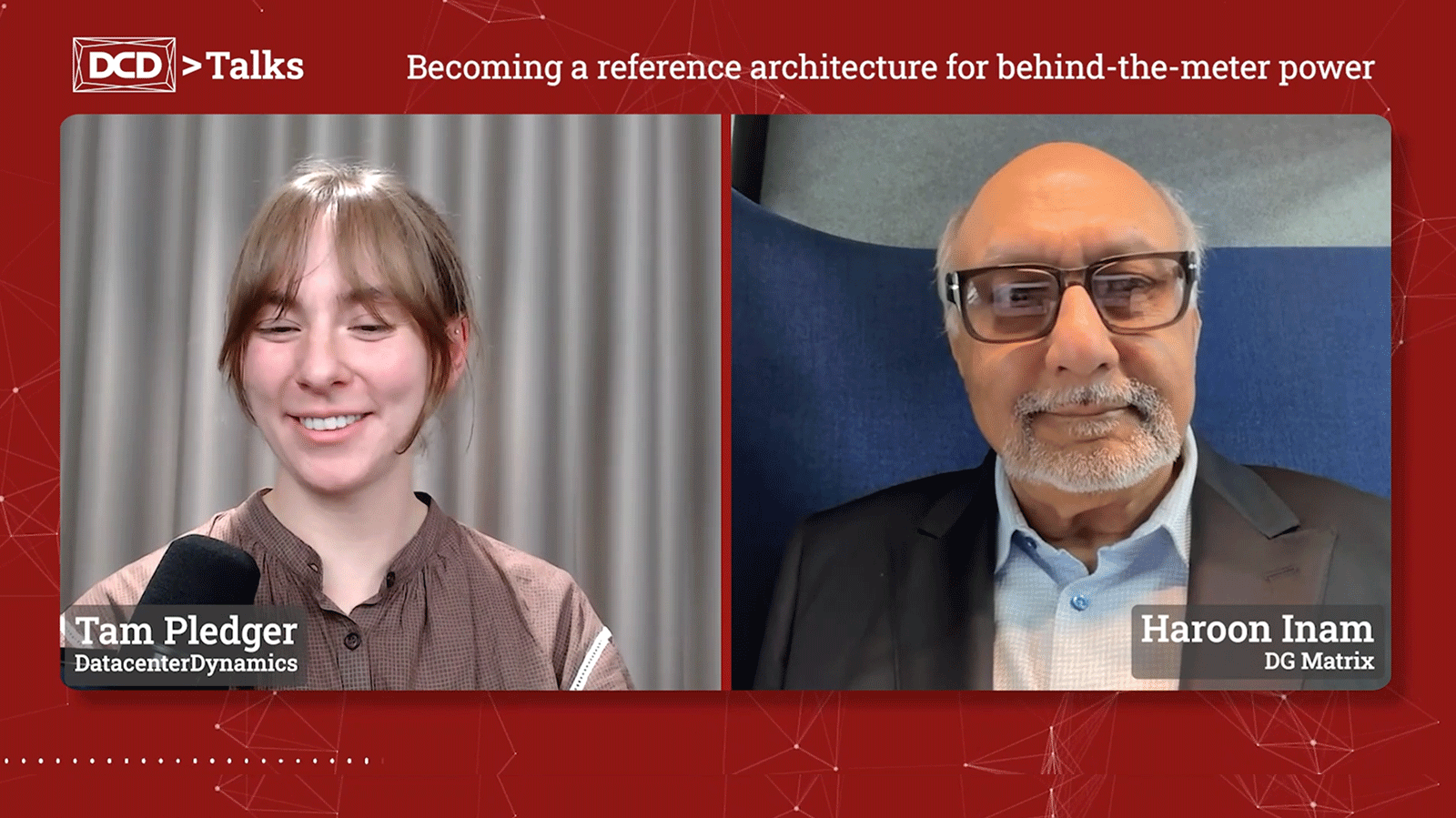
In a recent DCD>Talks interview with Data Center Dynamics (DCD), Haroon Inam, Co-Founder and Chief Executive Officer of DG Matrix, discusses the urgent need for scalable and resilient behind the meter (BTM) power architectures as data centers evolve to support Al driven demand. Haroon outlines how next generation power infrastructure must move beyond traditional utility dependent models toward flexible, modular systems that can seamlessly integrate grid power, renewables, and energy storage. He explains how DG Matrix's multi port solid state transformer (SST) InterportTMM platform enables a new reference architecture for BTM power, improving deployment speed, enhancing energy resiliency, and addressing grid interconnection constraints. As hyperscale and Al workloads push power requirements to unprecedented levels, standardized and intelligent BTM architectures are becoming essential to unlocking faster site activation and long term infrastructure scalability. Watch the full DCD Talks interview here: https://www.datacenterdynamics.com/en/videos/dcdtalks-becoming-a-reference-architecture-for-behind-the-meter-power-with-haroon-inam-dg-matrix/
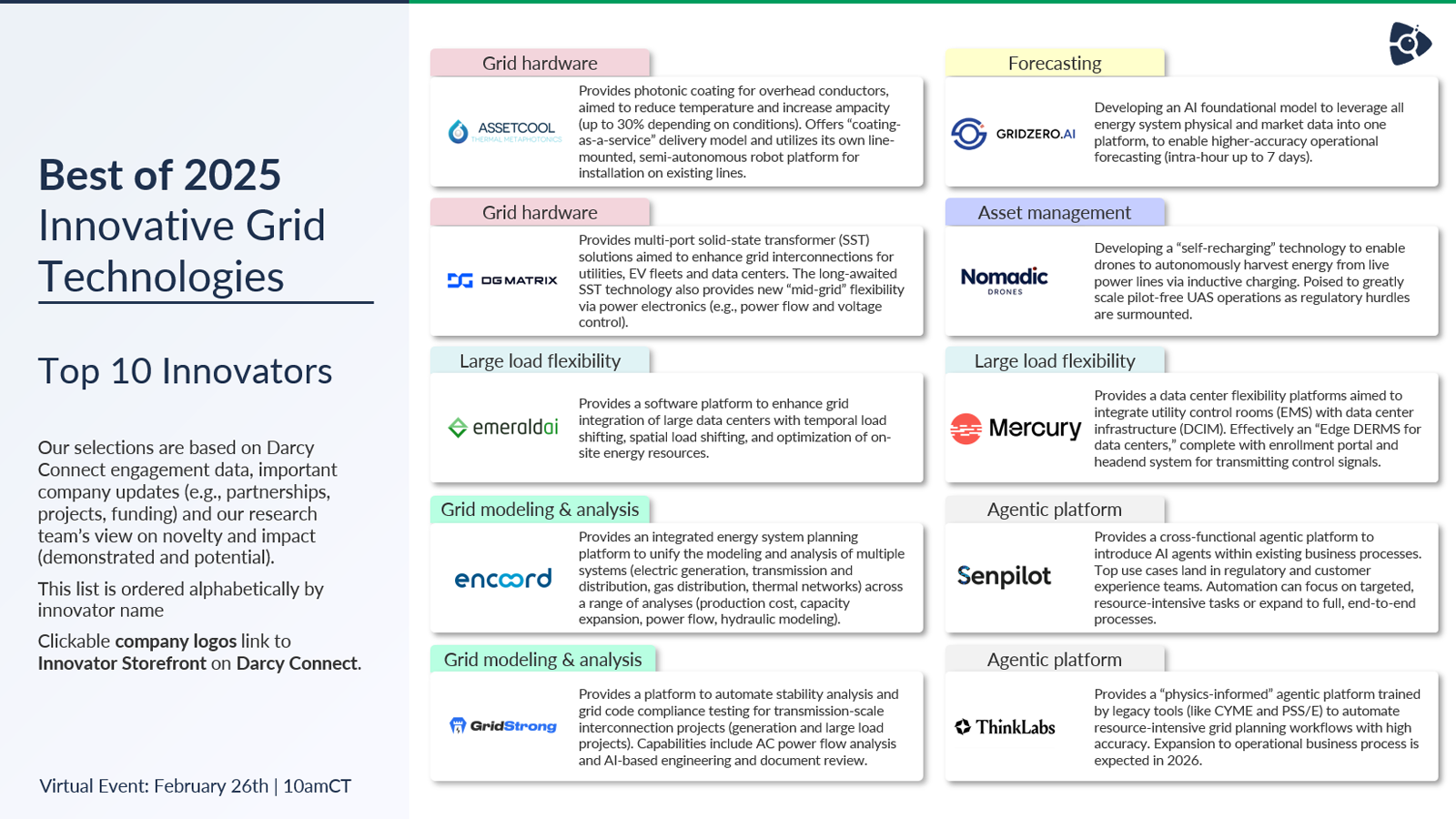
DG Matrix has been named one of the Top 10 Innovators in Innovative Grid Technologies in the Darcy Insights 2025 Review by Darcy Partners, a leading energy research and market intelligence firm. The recognition highlights DG Matrix’s advancements in solid-state transformer technology through its multi-port “Interport” platform, which simplifies the integration of solar PV, battery storage, generators, and modern loads into power infrastructure. With commercial units shipping, expanding traction in high-growth markets such as data centers, and strategic partnerships with companies including Exowatt and PowerSecure, DG Matrix continues to demonstrate strong momentum. In 2025, the company secured a $20 million seed round and a $60 million Series A financing, further reinforcing its leadership in next-generation grid hardware innovation.
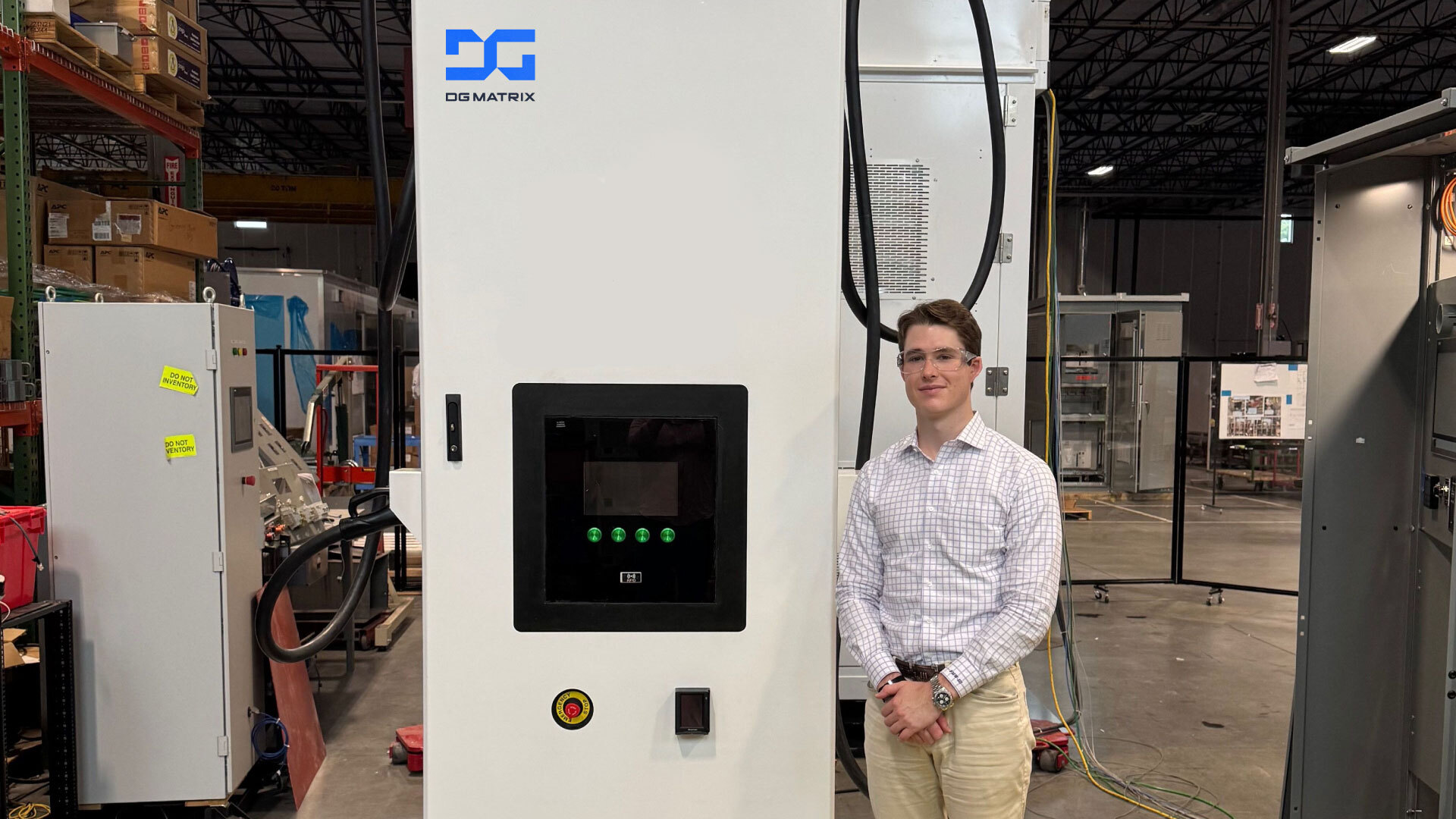
TechCrunch’s Tim De Chant sat down with Haroon Inam and Dr. Bhattacharya to learn about the firm’s series A funding from Engine Ventures and the work going into launching Interport to the world.
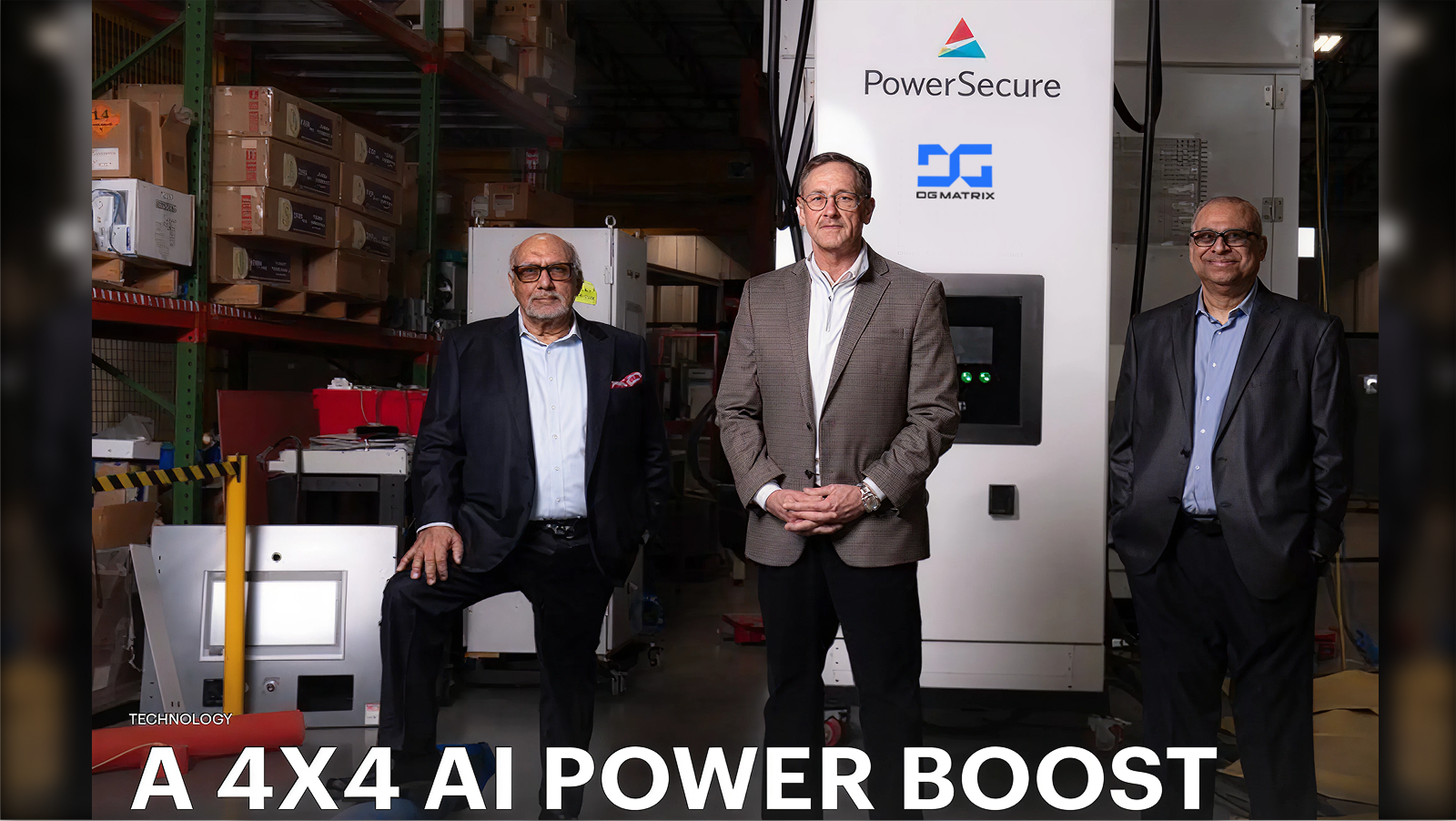
Read about DG Matrix and PowerSecure’s close partnership to power AI in this feature in the Research Triangle’s leading business publication, the Triangle Business Journal.
RALEIGH-DURHAM, N.C., Dec. 9, 2025 – DG Matrix, the global leader in solid-state transformer solutions, and PowerSecure, a national leader in distributed energy solutions, today announced a strategic collaboration to deliver next-generation energy systems for AI data centers and electrification projects. DG Matrix will provide its advanced solid-state transformer technology and Power Router platform to simplify power conversion and enable integration of renewables, storage, and grid resources. PowerSecure will bring unmatched expertise in microgrid solutions and customer-focused innovation, with a proven record of helping businesses achieve superior resiliency and reduced energy costs. "This partnership provides DG Matrix with a nationwide energy partner to help accelerate commercialization and scale," said Haroon Inam, CEO of DG Matrix. "Through PowerSecure's market access and operational capabilities, we gain immediate customer channels, deployment capacity, and service coverage for our Power Router platform. Together, we're setting a new benchmark for distributed energy and AI data center infrastructure." Together, DG Matrix and PowerSecure combine cutting-edge technology with proven energy infrastructure expertise to accelerate innovation—ultimately delivering faster, more resilient, and scalable power solutions that meet the growing demand for reliable and sustainable energy. “PowerSecure is excited to work alongside DG Matrix to provide next-generation energy systems,” said Jim Smith, president of PowerSecure. “This collaboration accelerates the path from concept to deployment by integrating DG Matrix’s technology with PowerSecure’s delivery and lifecycle support, enabling customers to meet dynamic AI load requirements with faster execution, greater resiliency, and scalable, future-ready infrastructure.” About DG Matrix DG Matrix has commercialized the world’s first multi-port solid-state transformer to solve the most urgent challenges in deploying power infrastructure for AI data centers and electrification. Its standardized platform enables faster deployment, lower energy costs, and flexible integration of all energy sources and loads—at scale, anywhere in the world. About PowerSecure PowerSecure, a subsidiary of Southern Company, stands at the forefront of the distributed energy infrastructure sector in the United States. With a rich history spanning more than two decades, PowerSecure’s dedicated team of professionals has successfully developed, installed, managed, and serviced over 3 gigawatts of microgrid capacity. This achievement underscores PowerSecure’s commitment to advancing energy solutions that are both efficient and sustainable, including energy efficiency upgrades valued at more than $1 billion. To learn more, visit www.powersecure.com. Media Contact: Will Kruisbrink Will.Kruisbrink@ andorpr.com (217) 766-7894
RALEIGH-DURHAM, N.C. & MIAMI — DG Matrix, the global leader in solid-state transformer (SST) solutions, and Exowatt, the next-generation renewable energy company delivering dispatchable solar for the AI era, today announced a strategic partnership to deploy integrated, behind-the-meter power systems targeting gigawatt-scale (GW-scale) infrastructure buildouts. As part of the collaboration, Exowatt has selected DG Matrix’s Power Router™ as a preferred platform for power conversion for its modular energy architectures. This agreement enables Exowatt to integrate its proprietary Exowatt P3 generation and storage systems with hyperscale data centers more rapidly, addressing the urgent demand for reliable, carbon-free electricity to fuel the AI revolution. The partnership comes as Exowatt continues its rapid U.S. expansion following significant funding milestones to support American-made manufacturing. By using DG Matrix’s Power Router — the first commercially available solid-state transformer — Exowatt can simplify the complex power routing required to bridge its heat-battery-based solar technology with the rigorous uptime and power quality standards of modern AI compute loads. “To stay competitive in the AI era, the industry needs reliable, clean megawatts at speed,” said Hannan Happi, CEO of Exowatt. “DG Matrix’s Power Router provides the flexible, power-first foundation we need to scale our operations. By integrating their solid-state transformer technology into our ExoRise platform, we are eliminating traditional interconnection bottlenecks and accelerating our path to delivering firm, dispatchable power for the next generation of data center infrastructure.” The collaboration addresses one of the most critical challenges in the energy transition: connecting distributed renewable generation to mission-critical loads without compromising reliability. The DG Matrix Power Router™ functions as an intelligent hub, seamlessly managing power flows between Exowatt's dispatchable solar modules and the data center load. This "power-first" approach allows for repeatable, modular deployments that can scale from individual sites to multi-gigawatt portfolios. “Exowatt is approaching clean power with the scale and rigor that the hyperscale market demands,” said Haroon Inam, CEO of DG Matrix. “This partnership demonstrates how advanced power routing is essential to unlocking the full potential of next-generation energy sources. We are proud to support Exowatt in converting their momentum into gigawatts, providing the infrastructure-grade reliability required to power the AI future.” The Exowatt/DG Matrix infrastructure stack will offer: Integrated Architecture: Exowatt will deploy the DG Matrix Power Router™ to manage AC/DC power routing within its modular Exowatt P3 and ExoRise platforms. GW-Scale Readiness: The joint solution is designed for repeatability, supporting Exowatt’s backlog of demand from data centers and industrial applications. Accelerated Time-to-Power: The solid-state transformer technology reduces commissioning time and system footprint, enabling faster site activation independent of constrained grid interconnections. About DG Matrix DG Matrix has commercialized the world’s first multi-port solid-state transformer to solve the most urgent challenges in deploying power infrastructure for AI data centers and electrification. Its standardized platform enables faster deployment, lower energy costs, and flexible integration of all energy sources and loads — at scale, anywhere in the world. About Exowatt Exowatt is a next-generation renewable energy company providing modular energy solutions tailored for energy-intensive applications such as data centers. Founded in 2023 by Hannan Happi and Atomic CEO Jack Abraham, Exowatt’s mission is to make sustainable renewable energy always available and almost free. Exowatt is backed by a16z, Atomic, Felicis, and Sam Altman and is headquartered in Miami, Florida. For more information, visit www.exowatt.com For DG Matrix: Will Kruisbrink Will.Kruisbrink@ andorpr.com (217) 766-7894 For Exowatt: Fatimah Nouilati fatimah.nouilati@ allisonworldwide.com (978)-703-3124
Transforming Data Centers into AI Factories with Facility-Level Power Fabric Artificial intelligence is transforming traditional data centers into high-density AI factories that require fundamentally different power infrastructure. This white paper introduces the concept of a facility-wide power fabric built around multi-port solid-state transformer technology. Interport™ Unifies Power Conversion, Routing, Buffering, and Control The paper explains how DG Matrix Interport™ platform unifies power conversion, intelligent routing, buffering, and control into a single software-defined architecture. This simplifies infrastructure while supporting modular AI factory deployment and high-voltage DC power distribution. Standardized Energy Infrastructure for Modular AI Factory Deployment Future AI facilities require standardized, repeatable, and scalable energy infrastructure. This white paper demonstrates how facility-level power fabrics improve deployment speed, operational flexibility, and long-term infrastructure resilience. Tags AI Factories Facility Power Fabric Multi-Port Solid-State Transformer (SST) Interport Software-Defined Power Power Conversion Intelligent Routing 800 VDC Modular AI Factory Data Center Power Infrastructure
Accelerating AI Factory Deployment with Solid-State Transformer Technology Deploying AI factories requires more than advanced GPUs and networking—it requires intelligent power infrastructure capable of scaling efficiently. This white paper explores how solid-state transformers improve deployment speed, capital efficiency, and long-term operational performance. Software-Defined Power Platforms for AC and DC Energy Integration The paper discusses how software-defined power platforms replace fragmented electrical architectures with a standardized energy system that integrates multiple AC and DC energy sources. This enables faster deployment while improving utilization and simplifying infrastructure expansion. Improving AI Infrastructure ROI with Scalable Intelligent Power Systems Organizations competing in the AI economy must accelerate infrastructure deployment without increasing operational complexity. Intelligent power platforms help maximize return on investment while supporting scalable AI infrastructure worldwide. Tags AI Factory Solid-State Transformer (SST) AI Infrastructure ROI Software-Defined Power AC and DC Energy Sources Intelligent Power Systems Deployment Speed Capital Efficiency Energy Scalability Power Infrastructure
Reducing Time-to-Power for AI Data Center Development Reducing the time required to deploy electrical infrastructure has become essential for AI data center development. This white paper examines how solid-state transformers enable faster implementation of end-to-end 800 VDC power architectures from the utility grid to high-density GPU racks. Interport™ SST for Native AC/DC Integration and 800 VDC Architectures The paper explains how DG Matrix Interport™ platform simplifies power conversion, supports native AC and DC integration, and reduces the number of conventional electrical components required throughout the facility. This approach accelerates deployment while improving overall system efficiency. Accelerating Grid-to-Rack Deployment for Future AI Infrastructure Time-to-power is becoming one of the primary constraints on AI growth. Organizations adopting software-defined power architecture can significantly reduce deployment timelines while preparing for future AI infrastructure requirements. Tags Speed-to-AI Power Time-to-Power Grid-to-Rack 800 VDC Solid-State Transformer (SST) Interport AC/DC Integration AI Data Centers Power Conversion Software-Defined Power Architecture
